

There are men who mistake control for safety.
Adrian Vale had made a life from that mistake. He lived on the twenty-third floor of a glass building in London, where every window sealed shut and every day could be divided into manageable appointments. He knew how to keep his voice level, his shirts immaculate, his relationships undefined. He knew how to leave a room before anyone could ask the question beneath the question.
He did not know how to stand above the ground.
So when his closest friend sent him to Bellwether, a small rural town famous for its autumn hot-air-balloon festival, Adrian told himself he was going for the photographs. For the quiet. For one weekend away from the city.
He did not tell himself he might meet Jonah Reed, a balloon pilot who believed the sky was not something to conquer, but something to listen to.
The Town Beneath the Mist
Bellwether woke before the sun.
Dawn mist lay over the fields in pale, uneven ribbons, collecting between hedgerows and curling around the wooden posts of the festival grounds. Beyond them, the town was little more than a cluster of brick buildings, church spires and dark shopfronts waiting for morning. The air smelled of cut grass, strong coffee and propane.
Adrian stood at the edge of the field with both hands around a paper cup. He had slept badly in the guesthouse, disturbed by unfamiliar quiet. In London, there was always a siren, a lift, a neighbour, a train moving somewhere beyond the walls. Here, the silence seemed to have weight.
Then the first burner ignited.
The roar rolled across the grass, sudden and physical. Adrian felt it in his ribs. Around him, crews moved between ropes and baskets, their voices low and practical. Bright fabric began to lift from the ground. Envelopes unfolded like enormous sleeping creatures stretching toward consciousness.
“First time?” a man asked.
Adrian turned.
Jonah Reed stood beside him in a faded green jacket, his hair damp with mist, his face marked by the kind of calm that did not come from having an easy life. There was a burn scar across two fingers of his right hand. His eyes were the colour of rain over fields.
“Is it that obvious?”
“You’re holding the coffee like it’s an anchor.”
Adrian looked down. “I like anchors.”
Jonah smiled, but he did not laugh. “Most people do, until they realise they’re also weights.”
The answer should have annoyed him. Instead, Adrian felt something inside his carefully arranged life shift half an inch.
A Pilot Who Reads the Wind
Jonah’s balloon was called The North Star. Its envelope was deep green and cream, patched in one place near the lower seam. The wicker basket creaked as the crew checked it. Ropes tightened. Metal clips clicked into place. Above them, the envelope swelled as the burners breathed heat into it.
Jonah explained that balloons did not travel by engine or rudder. The pilot could rise by heating the air inside the envelope and descend by allowing it to cool or opening a vent. Horizontal movement belonged to the wind.
“You choose the layer,” he said. “The wind chooses the direction.”
“That sounds less like flying than surrender.”
“It’s neither.” Jonah looked up at the balloon. “It’s cooperation.”
He had learned that from his brother, Eli, who had taught him to fly. Eli had been the brave one, the person who could look at a wide sky and see not danger but possibility. After Eli died, Jonah kept flying because stopping felt too much like agreeing that the sky had won.
But grief had changed the way he flew. He no longer chased height for its own sake. He listened to the wind, watched the trees, studied the movement of mist in the hollows. He knew that some mornings were made for rising and some were made for staying tethered to the earth.
His quiet fear was not falling.
It was being left behind.
Every festival, he watched other balloons climb while he remained below, checking ropes, reading instruments, waiting for the right conditions. Sometimes he wondered whether the life he had built was a tribute to Eli or simply a way of avoiding another goodbye.
Adrian understood that kind of avoidance. He had spent years calling it professionalism.
The Man Who Had Not Yet Named Himself
Adrian had known he was bisexual for most of his adult life. He had also known how to speak around it.
He had dated women because desire for women was real, and because it offered him a language his family understood. He had loved men because desire for men was real, and because those feelings had always seemed to ask more of him. Not more love. More truth.
With men, he felt visible.
He feared the moment someone might look at him and understand the whole of him at once: the attraction, the uncertainty, the history of retreating whenever intimacy became a witness stand.
He had not come out to his parents. He had not said the word bisexual at work. He had never introduced a man as someone he loved.
Jonah did not demand an explanation. He did not turn Adrian’s silence into a puzzle he had the right to solve. He simply handed him another coffee and asked whether he wanted to see the basket.
The intimacy of that restraint unsettled Adrian more than pressure would have done.
When Jonah invited him aboard The North Star, Adrian nearly refused.
“I don’t like heights.”
“I know.”
“You’ve known me for forty minutes.”
“You’ve been watching the ground as if it might betray you.”
The burner roared above them. The basket shifted.
Adrian’s pulse began to climb.
Jonah offered his hand. “You don’t have to go up.”
The choice was the frightening part.
The Release of the Tether
The balloon rose slowly at first.
The wicker basket gave a long, complaining creak. The rope at the edge of the field tightened. Adrian could hear the festival below: voices calling, burners flaring, boots moving through wet grass. Every instinct told him to grip the basket and demand a return to solid ground.
Jonah stood close enough that their shoulders touched.
“Look at me,” he said.
Adrian did.
The balloon lifted another few feet. The town seemed to loosen beneath them. The church spire lowered. The people became small, moving shapes. Above, the envelope filled with morning light.
“Breathe,” Jonah said.
“I am breathing.”
“You’re negotiating with oxygen.”
Despite himself, Adrian laughed. The sound surprised him. It felt young.
Then came the moment he had been dreading: the tether released.
Not dramatically. There was no violent lurch, no sudden plunge into danger. One second the rope held them to the field; the next, it did not.
Adrian felt the absence like a door opening beneath his feet.
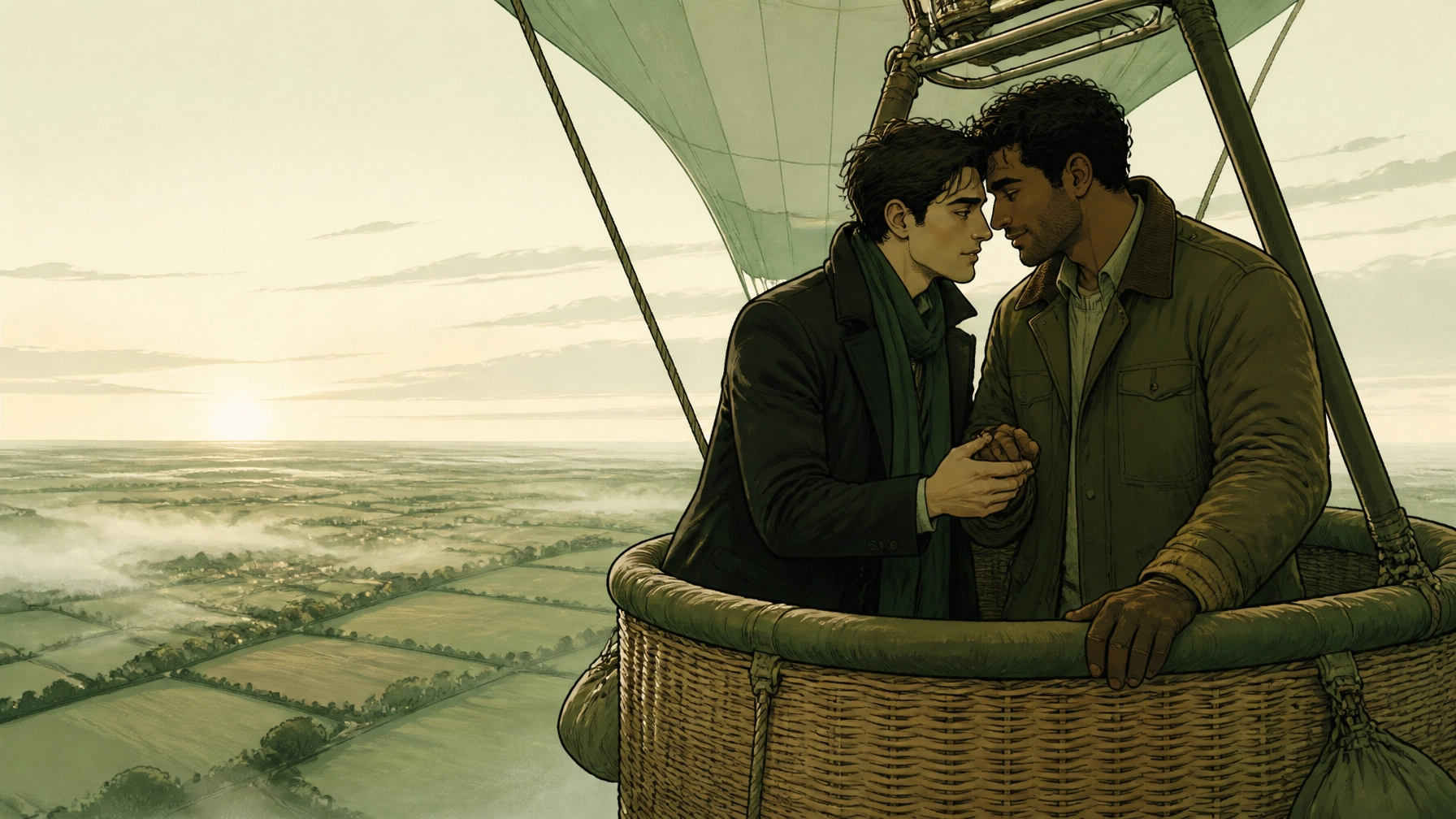
Jonah’s hand found his.
The silence after the burner cut was immense. Wind moved through the envelope overhead with a soft, fabric hush. The balloon drifted above the patchwork fields, carried by air that could not be seen but could be trusted.
From above, the rural landscape became something almost abstract: green squares, brown furrows, narrow roads shining with damp. In the distance, the town glittered beneath them, its windows catching the weak gold of the sun.
Adrian looked down.
He was still afraid.
But fear had stopped being a command.
What Falling Really Means
They flew for less than an hour.
Jonah changed altitude in careful increments, feeling for the different wind currents. At one height they moved east; at another, they drifted south toward the river. Adrian watched him work: the brief flare of the burner, the measured glance at the instruments, the relaxed hand on the rope.
Jonah was not passive. He was not surrendering control. He was accepting the limits of control and becoming more attentive because of them.
Adrian understood, with painful clarity, how different that was from his own life.
He had believed that if he controlled every detail, no one could leave him unexpectedly. If he avoided naming himself, no one could reject the truth. If he never let a man stand beside him in full daylight, no one could see how deeply he wanted to be known.
“I’m bisexual,” he said.
The words disappeared into the wind.
Jonah did not look startled. “Thank you for telling me.”
“I’ve never said it like that.”
“Then I’m glad I was here.”
Adrian tightened his fingers around Jonah’s. The gesture was small, almost invisible from the ground. Yet people below could see the balloon. They could see the basket carrying two men into the open sky.
For once, being witnessed did not feel like exposure.
It felt like existence.
Coming Down Together
They landed in a meadow beyond the festival, where the grass was flattened by the morning dew. The basket bumped once, twice, then settled. The envelope sighed as Jonah opened the vent. The great green shape folded toward the earth.
The return did not erase what had happened above them. That was the lesson Adrian had expected least.
Rising was not the opposite of coming down.
The point was not to remain in the air forever. The point was to learn that descent could be deliberate, shared and safe.
Jonah told him about Eli while they packed the ropes away. He spoke without turning the grief into a performance. Eli had been the first person to tell him that loving the sky did not mean abandoning the ground. After his death, Jonah had feared every departure would become another permanent loss.
“I keep thinking,” Jonah said, “that if I stay here, I can stop people from leaving.”
Adrian looked at the folded envelope, the empty basket and the long grass bending in the wind.
“You can’t keep anyone from leaving.”
“No.”
“But you can choose who you return with.”
Jonah’s expression changed then. Not into certainty. Something gentler. The beginning of it.
They walked back toward the festival together. Later, at sunset, the balloons glowed across the field like suspended lanterns. The burners pulsed orange inside the darkening envelopes. Coffee steamed from paper cups. The town gathered below, looking upward.
Adrian stood beside Jonah without hiding the shape of their closeness.
He had not solved his life in one flight. He had not told every person who needed telling. There would be difficult conversations, old fears and days when the ground felt safer than the sky.
But when Jonah reached for his hand, Adrian did not pull away.
Sometimes falling is how you rise: not because the fall is harmless, but because someone teaches you that losing the tether is not the same as losing yourself.
Why This Setting Works for Emotionally Invested MM Readers
A hot-air-balloon festival creates an ideal setting for emotionally immersive MM romance, especially for readers who want more than an uncomplicated love story.
The balloon offers a visual language for vulnerability. Adrian’s fear of heights is also his fear of being seen, naming his bisexuality and allowing another man to matter. Jonah’s relationship with the sky reflects a different struggle: grief, responsibility and the dread of watching someone rise beyond his reach.
The rural setting intensifies the contrast between them. Adrian arrives from a city built upward in glass and steel, yet he has never felt free. Jonah lives among open fields, but grief has kept him emotionally tethered. Neither man is automatically wiser because of where he comes from. Their connection works because each challenges the other’s assumptions.
For readers searching for emotional MM books, heartfelt gay fiction, gay love stories, character-driven MM romance and queer fiction about coming out and vulnerability, the festival provides more than atmosphere. It becomes an active force in the story.
The roar of the burner, the creak of wicker, the changing wind and the silence above the fields all mirror the emotional movement between two men learning that trust is not the absence of fear. It is the decision to keep reaching through it.
Read with Pride
If you are looking for gay books, MM novels, LGBTQ+ fiction, gay literature, gay romance books and emotionally charged stories about men who love, struggle and grow, explore the Read with Pride home page.
You can also discover Dick Ferguson’s collection of MM romance books, gay psychological fiction, queer love stories and other LGBTQ+ ebooks in the Dick Ferguson Read with Pride e-book store.
For readers who love intense emotional journeys, bisexual representation, coming-out stories, possessive longing, grief and hard-earned connection, these are stories written for the place where romance becomes personal.
Three Possible Next Evening Edition Stories
-
The Last Ferry Across the Reservoir
A guarded city architect misses the final ferry and is stranded overnight with the rural boatman who has spent years waiting for his estranged brother to come home. Across the dark water, both men must decide whether a life built around departure can make room for staying. -
The Orchard After the Storm
A bisexual museum curator arrives in a small village to catalogue an abandoned orchard and meets the man trying to save it. As fallen branches reveal letters hidden beneath the roots, the two men confront family silence, inherited grief and the possibility of growing something new. -
The Lighthouse Keeper’s Winter Light
A man who has never admitted what he wants takes refuge in a remote lighthouse after a public professional failure. The keeper, grieving the loss of his former partner, teaches him that illumination is not the same as exposure: and that two men can become each other’s way home.
Follow us on social media for more emotionally immersive stories, queer fiction recommendations and new MM romance conversations:
#EveningEdition #MMRomance #QueerFiction #GayFiction #GayRomance #MMBooks #MMNovels #LGBTQBooks #BisexualRepresentation #QueerLiterature #GayLoveStories #EmotionalMM #CharacterDrivenRomance #ReadingWithPride


Leave a Reply
You must be logged in to post a comment.