

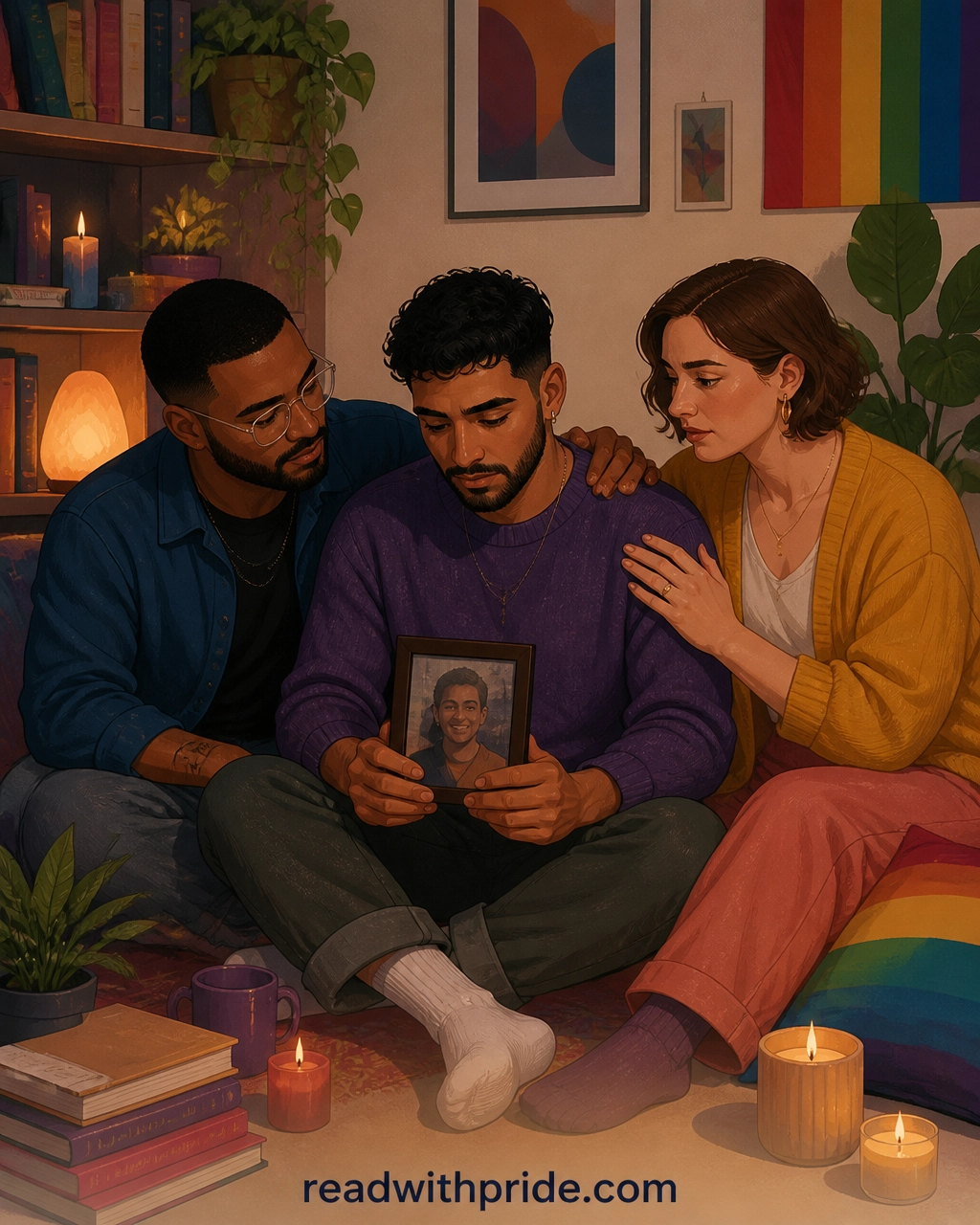
Grief does not always arrive with a clear goodbye.
Sometimes it follows the death of a partner, friend, relative, mentor, or chosen-family member. Sometimes it comes from family rejection, the end of a relationship, years spent hiding, or the younger version of yourself who never received the safety and affirmation they needed.
Sometimes we grieve a future we once imagined.
For LGBTQ+ people, loss can be complicated by the fact that our grief is not always recognised by the people or systems around us. A partner may be described as “just a friend”. A chosen-family member may be excluded from important conversations. The pain of estrangement may be dismissed. The years spent surviving rather than living may be treated as though they do not count.
They count.
This is why queer healing matters. It gives us space to name what happened, honour what mattered, and begin imagining something beyond survival. It does not ask us to pretend the past was painless. It reminds us that pain is not the only possible ending.
Grief is not a tidy storyline
We are often taught to treat grief like a task with a deadline. Cry for a while. Take some time off. Return to normal. Smile convincingly when someone asks how you are doing.
But grief is not a project plan, and healing is not a performance review. There is no universal timetable, no correct sequence, and no gold star for appearing fine before you actually feel fine.
Queer grief can move in unexpected patterns. You might feel steady for several days, then be overwhelmed by a song, a photograph, a familiar street, or a message that never arrives. You may feel sadness and relief at the same time. You may miss someone deeply while also recognising that the relationship was complicated, unsafe, or unfinished.
None of this means you are healing incorrectly.
A gentler set of questions might be:
- What has this loss changed for me?
- What do I need today?
- Who can sit with the truth without trying to edit it?
- What part of my experience has not yet been witnessed?
These questions make room for the whole story, not just the socially acceptable parts.

Naming the losses people do not always see
Some losses are obvious. Others are quieter, but no less significant.
You may be grieving:
- A family relationship that changed after you came out.
- A first love that could not survive prejudice or secrecy.
- Time spent masking, hiding, or trying to appear less queer.
- A childhood without the reassurance you deserved.
- A community space that once made you feel visible and safe.
- A dream of partnership, home, family, or adulthood that no longer fits.
- A version of yourself you had to leave behind to keep going.
Naming these experiences is not self-indulgent. It is a way of refusing erasure.
Your grief does not have to be dramatic to be real. You do not need a perfect explanation. You do not have to prove that the loss was important before you are allowed to feel it.
Queer healing can begin with the simple sentence: “This mattered to me.”
For some people, that sentence emerges in therapy or a support group. For others, it begins with journalling, music, art, prayer, nature, a long walk, or a conversation with someone from their chosen family. There is no single correct doorway into healing. The useful doorway is the one that feels safe enough to enter.
LGBTQ+ resilience is not the same as being indestructible
Resilience is often portrayed as the ability to withstand anything. In LGBTQ+ communities, that idea can become exhausting. We are frequently praised for being strong when what we actually needed was support.
LGBTQ+ resilience is not the requirement to remain cheerful, productive, or inspirational while carrying pain. It can be much softer than that.
Resilience might look like:
- Asking a friend to stay on the phone while you make a difficult call.
- Turning off notifications when the world feels too loud.
- Eating something simple and getting some sleep.
- Setting a boundary with someone who minimises your identity or grief.
- Letting yourself be witnessed instead of pretending everything is fine.
- Finding an LGBTQ+-affirming therapist or support space.
- Choosing rest before you reach complete burnout.
- Laughing without feeling guilty because you are still mourning.
- Beginning again without pretending the first ending did not hurt.
There is strength in staying connected to your humanity after being told that your humanity was the problem. There is strength in choosing tenderness when the world has taught you to expect rejection.
And there is strength in accepting help before you reach breaking point.
Community care is practical, not performative
When someone is grieving, grand speeches are not always what they need. Often, the most meaningful care is wonderfully ordinary.
Bring food. Sit quietly. Walk the dog. Help with forms or phone calls. Send a message that does not demand a reply. Remember important dates. Offer to go with them to an appointment. Ask what kind of support would feel useful instead of assuming you already know.
In queer communities, practical care can also mean understanding the realities around someone’s loss. It may mean respecting their pronouns, recognising a chosen-family member as immediate family, or ensuring that a partner is not excluded from decisions.
Try asking:
- “Would you like company, practical help, or space?”
- “Who feels safe for you right now?”
- “Is there anything you do not want to discuss?”
- “What would make today slightly easier?”
- “Can I check in again tomorrow?”
Sometimes the most healing sentence is simply: “I believe you, and I am not going anywhere.”
Community care also needs boundaries. You cannot be everything to everyone, and caring for others should not require abandoning yourself. A sustainable support network is made from many hands, not one exhausted person trying to carry the entire emotional furniture of the group.

Future visions give hope somewhere to land
Hope can feel complicated when grief is fresh. Optimism that arrives too quickly may feel like pressure. You do not have to force yourself to imagine a bright future before you are ready.
But gently, and at your own pace, future visions can help create a direction beyond survival.
A future vision is not a demand to become a new, improved version of yourself. It is a small picture of a life that feels more honest, spacious, safe, and connected.
Maybe it includes a home where your name and pronouns are respected. A partner who listens. Friends who understand the difference between support and unsolicited advice. A lesbian romance, gay love story, or piece of queer fiction that lets you experience tenderness without punishment.
Maybe it includes a community garden, a creative group, a queer book club, or an online space where you can arrive exactly as you are.
The future does not have to be perfect to be worth imagining.
Try asking yourself:
- What am I grieving today?
- What is helping me carry it?
- What is one possibility I want to make room for?
That possibility might be very small. Cooking dinner. Reading a few pages. Replying to one message. Visiting a place where you feel safe. Making plans for next month instead of trying to solve the next ten years.
Hope is not denial. It is the decision to believe that grief is not the only story available.

Let queer stories help you imagine more
Stories cannot erase loss, but they can remind us that our lives contain more than pain. Queer fiction offers language for complicated feelings, recognition for experiences that are often ignored, and visions of relationships built on honesty rather than compulsory rules.
A heartfelt book can be company. A romance can offer emotional breathing room. A story about chosen family can remind us that belonging is something we can create, not only something we inherit.
At Read with Pride, we believe LGBTQ+ ebooks should hold the full range of queer life: desire, heartbreak, humour, anger, healing, tenderness, and hope. Our collection includes gay fiction, lesbian romance, MM fiction, LGBTQ+ novels, queer love stories, and stories that allow queer characters to be complicated and fully human.
Readers looking for reflective LGBTQ+ fiction 2026 can explore Beyond Survival: A Practical Guide to LGBTQI+ Anxiety, an affirming guide focused on stress, hypervigilance, internalised shame, and the patterns many of us develop to feel safe.
For readers who prefer future-facing stories, The Majority Rule: Love in 2150 imagines a world where social power has shifted, but oppression has not disappeared. Its relationship between Kai and Dash explores love, found family, political courage, and the work required to build a better future rather than simply inherit one.
You can also browse Readwithpride’s LGBTQ+ blogs and articles for reflections on queer life, identity, relationships, community, and healing.
And yes, if you arrived here while searching for “C Section 2026,” this article is not medical guidance. It is a reflection on queer healing, grief, and future visions. For health-related questions, please speak with a qualified medical professional.
Carrying grief and hope together
Healing does not mean leaving the past behind as if it never happened. It means finding ways to carry what mattered without allowing loss to decide the shape of your entire future.
Some days, healing will look like tears. Some days, it will look like laughter in a group chat, a quiet cup of tea, a page-turning late at night, or an unexpected moment of peace. All of it counts.
You are allowed to mourn what you lost. You are allowed to celebrate what remains. You are allowed to imagine a future that would have surprised the version of you who was only trying to get through the day.
That future may not arrive all at once. It may begin as a conversation, a boundary, a book, a friendship, or a meal shared around a table.
Small hopes are still hopes. Together, they can become a life.
If grief feels overwhelming, unsafe, or impossible to navigate alone, please reach out to an LGBTQ+-affirming mental health professional, a trusted person, or a local crisis support service. You do not have to carry everything by yourself.
Ready to find stories that hold both the ache and the possibility? Visit readwithpride.com, browse our MM romance books and gay romance novels, and discover queer stories for every mood: from coming out stories and emotional gay fiction to lesbian romance, LGBTQ+ novels, and hopeful queer love stories. Then follow Read with Pride on Facebook and Instagram for more LGBTQ+ reading, reflection, and community.
#QueerHealing #FutureVisions #LGBTQResilience #ReadWithPride #LGBTQFiction2026 #QueerFiction #GayFiction #LGBTQNovels #QueerLoveStories #ComingOutStories #QueerBookClub #LGBTQReading

Leave a Reply
You must be logged in to post a comment.