

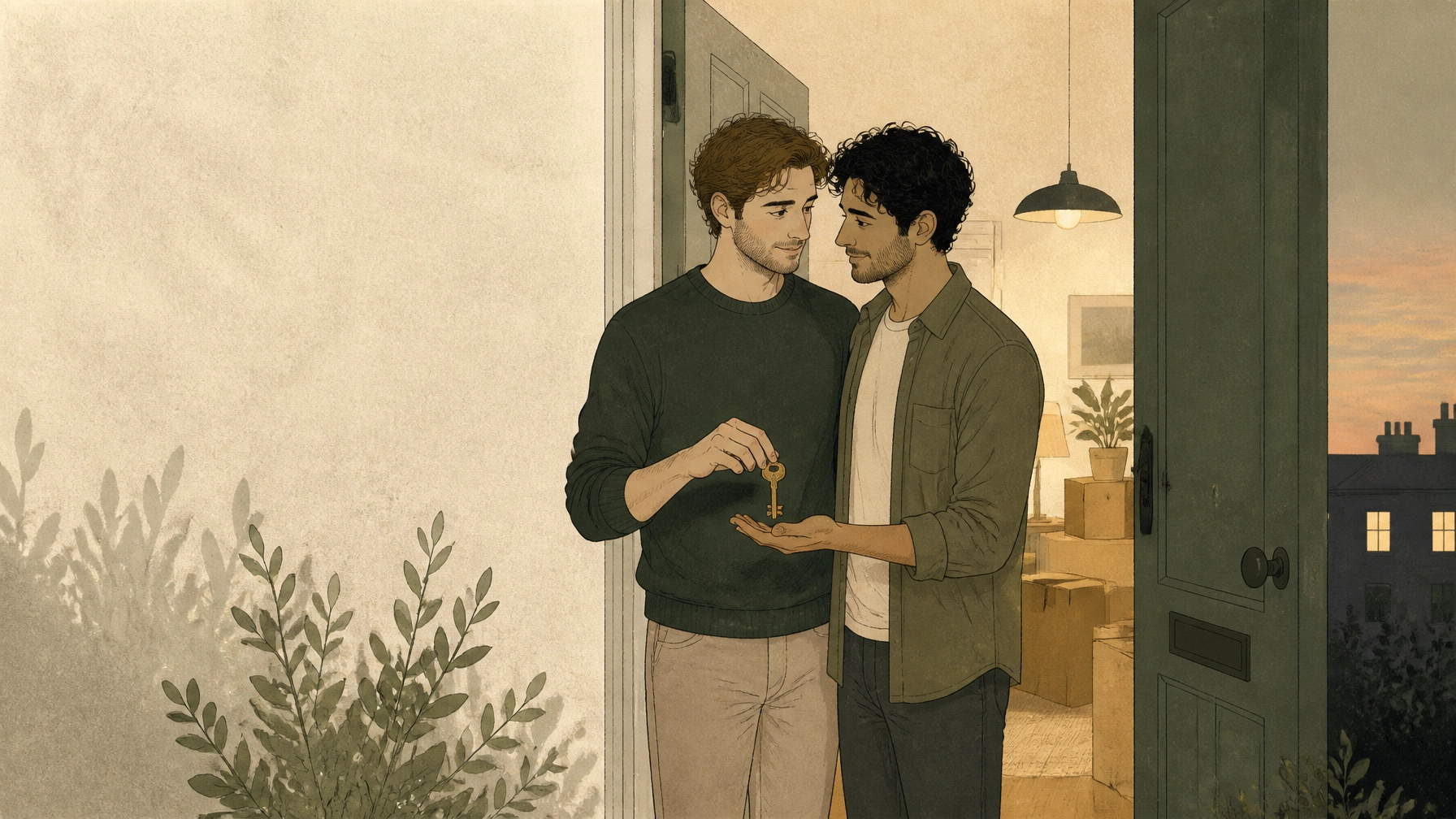
There are grand declarations of love, and then there are the quiet ones.
A proposal beneath a summer sky. A name spoken aloud after years of silence. A hand reaching across a crowded room and finding another hand waiting.
And then there is a key.
Small enough to disappear into a pocket. Cold enough to carry the memory of metal against the skin. Ordinary enough to be overlooked by anyone who does not understand what it means.
For two men standing at the threshold of a shared life, a house key can become something more than an object. It can become an answer to an old question: Do I belong here?
The first key is never only a key
Elias had lived alone for six years before Tom arrived.
His flat was not unhappy. It had plants on the windowsill, books stacked in uneven columns, and a blue mug with a chipped handle that he refused to throw away. It had the disciplined quiet of a place arranged around one person’s habits.
The heating came on when Elias wanted it. The kitchen light stayed on until midnight. The spare room held a desk, two suitcases, and the private evidence of a life that had learned not to expect anyone else.
Tom entered that life gradually.
First, he stayed late.
Then he began leaving things behind: a toothbrush, a paperback, a grey jumper draped over the back of a chair. His presence gathered in the flat almost without permission. A second voice in the hallway. A second pair of shoes near the door. The sound of someone opening a cupboard and asking where the tea was.
They were still living separately. Their addresses remained different. Their routines had not yet become one rhythm.
But the flat had begun to make room.
That is often how love changes us. Not with a single dramatic rearrangement, but through small permissions. A drawer emptied. A shelf cleared. A name added to an emergency contact list. A side of the bed no longer described as “your side” because it has become simply where you sleep.
The first shared house key belongs to that same language of permission.
It says: You do not have to wait outside.
Moving from separate lives towards a shared home
For many couples, receiving a key marks the beginning of a new stage in the relationship. It can signal trust, practical closeness, and the desire to let another person enter the unedited version of daily life.
Not the restaurant version.
Not the carefully chosen outfit and candlelit table version.
The real version.
The overflowing laundry basket. The forgotten appointment. The bad mood after work. The packet of biscuits hidden behind the flour. The silence that arrives without needing to be explained.
For an MM relationship, the emotional meaning can be especially powerful when both men have spent years deciding which parts of themselves are safe to reveal. A shared home offers no guarantee that fear will disappear. It does, however, create a place where honesty can become a daily practice.
A home is where the performance ends.
It is where a man can say, “I am frightened,” without shaping the confession into something more acceptable. It is where he can admit that he does not know how to be loved without expecting the love to leave. It is where two men can learn that intimacy is not only passion, but patience.
The key opens that possibility.

The courage of being expected
Tom had always been good at leaving.
He had left jobs before they could dismiss him. Left friendships before they could become disappointing. Left relationships at the first sign that happiness might require him to be seen too clearly.
Elias knew this because Tom had told him. Not dramatically. Not during an argument. He had mentioned it one evening while standing barefoot in the kitchen, watching rain draw crooked lines down the window.
“I’m better at arriving than staying,” Tom had said.
Elias had not tried to fix the sentence. He had only reached for Tom’s hand.
That moment mattered more than any promise to be different. It acknowledged that love cannot erase a person’s history. It can only offer them a new way to live alongside it.
When Elias gave Tom the key, he did not present it as proof that everything would be easy. He did not say, “This means you will never hurt me,” because no honest relationship can make that promise.
Instead, he said, “Come in whenever you need to.”
The words held a quiet vulnerability.
They also contained a boundary.
A key is not ownership. It is not unrestricted access to another person’s time, body, privacy, or emotional energy. The most meaningful shared homes are not built from possession. They are built from consent, communication, and the understanding that welcome is strongest when it is freely given.
Tom closed his fingers around the key.
For a moment, neither man spoke.
The metal rested between their palms, warm from Elias’s hand and then warm from Tom’s. It was a simple object carrying an immense weight: trust, fear, hope, and the possibility of a future that would have to be made rather than merely imagined.
Home is made of ordinary evenings
The first night Tom used the key, Elias was not home.
That was important.
There was no waiting by the door. No carefully prepared meal. No staged proof that the gift had transformed them into a perfect couple.
Tom arrived carrying groceries and the exhaustion of a difficult day. He stood in the hallway, placed the key in the lock, and turned it.
The sound was almost nothing.
A small metallic click.
Yet he felt it in his chest.
Inside, the flat looked exactly as it had that morning. The books were still untidy. The blue mug still sat beside the sink. A lamp glowed in the sitting room because Elias had left it on for him.
Tom put the groceries away. He watered the plants badly. He changed into one of Elias’s old T-shirts and waited.
When Elias came home, he found Tom asleep on the sofa with a book open against his chest.
He stood in the doorway for a moment, watching him.
There are kinds of happiness that arrive loudly, demanding recognition. And there are kinds that settle into the room like evening light. They are found in a second toothbrush. In a coat left on a hook. In the knowledge that someone may already be there when you return.
For emotionally invested readers, these are often the moments that make an MM romance unforgettable. The kiss matters, certainly. The conflict matters. The longing and jealousy, the fear of coming out, the difficult conversations about identity and trust: all of these can shape a powerful gay love story.
But the deepest emotional movement may happen when the men begin to share the unremarkable hours.
Love becomes credible in the spaces between plot points.
It lives in the question, “Did you eat?”
It lives in the hand placed gently against a trembling shoulder.
It lives in the first key.
A symbol of belonging, not perfection
Sharing a home does not mean two people stop being separate. Elias remains Elias. Tom remains Tom. They still carry different histories, different needs, and different ideas about what safety looks like.
A shared key should never erase those differences.
Instead, it represents the choice to build around them.
Perhaps one man needs quiet in the morning while the other talks before coffee. Perhaps one grew up believing that home could vanish overnight, while the other assumes there will always be somewhere to return to. Perhaps one has learned to hide his feelings, while the other experiences every emotion close to the surface.
The home becomes a place where these differences can be spoken about rather than weaponised.
The key does not promise that the door will always open onto peace.
It promises that the door can be opened.
That is a more human promise. A more durable one.

Why small milestones matter in gay romance
In many gay novels and LGBTQ+ stories, love is portrayed through moments of resistance: coming out, facing rejection, surviving secrecy, or choosing each other when the world insists they should not.
Those stories matter. They give language to pain and honour the courage it takes to live openly.
But queer fiction also deserves its quiet milestones.
Two men choosing curtains together.
Two men arguing about where the books should go and laughing before the argument becomes serious.
Two men standing in a hallway while one says, “You have a key now.”
These moments show queer love as more than survival. They show it as domestic, hopeful, complicated, and enduring. They allow gay romance to explore not only how men find one another, but how they build a life after finding one another.
That life will contain difficult days. It will contain old wounds and new misunderstandings. It will also contain warmth, humour, forgiveness, and the steady relief of being known.
A key cannot guarantee any of that.
But it can become a symbol of the decision to try.
The promise you can carry
Late that evening, Tom placed the key on the bedside table.
Elias reached for it and moved it closer to him.
“Keep it there,” Tom said.
“Why?”
“So I know where it is.”
Elias smiled. “You know where it is.”
Tom looked at him. “I mean, I want to know where home is.”
The sentence was not polished. It was not meant to be.
Elias understood anyway.
Home was not the flat. Not the furniture, the rent, the hallway, or the key. Home was the agreement between them: You can come in. You can be honest here. You do not have to become smaller to stay.
Outside, the evening gathered against the windows.
Inside, two men lay close in the dark, still themselves and no longer alone.
And on the table, a small piece of metal held the shape of a promise they could carry.
For readers looking for emotionally immersive MM romance books, heartfelt gay fiction, character-driven queer fiction, and stories about men who love fiercely while learning how to trust, discover more from Dick Ferguson through Read with Pride.
Follow us on social media
Follow Dick Ferguson for more literary reflections, emotionally charged gay love stories, and news about new LGBTQ+ ebooks:
#ReadWithPride #Readwithpride #MMRomance #GayRomance #MMBooks #QueerFiction #GayFiction #GayNovels #GayLoveStories #MMNovels #LGBTQFiction #GayLiterature #EmotionalMMBooks #HeartfeltGayFiction #GayRomanceBooks #MMRomanceBooks #LGBTQRomance #ReadingWithPride
Three new blog post options
-
The Second Mug: When Love Became Part of the Morning Routine
An intimate Evening Edition about the first everyday object a man leaves permanently in his partner’s home, and why ordinary domestic rituals can feel more frightening than grand declarations. -
The Name on the Emergency Contact Form: Choosing Each Other in a Crisis
A high-emotion MM relationship milestone exploring trust, vulnerability, and the quiet power of naming the man you love when life becomes uncertain. -
The First Photograph on the Wall: Making a Private Love Visible
A reflective gay romance essay about two men choosing a photograph for their shared home and confronting what it means to let their relationship become part of the visible world.


Leave a Reply
You must be logged in to post a comment.