

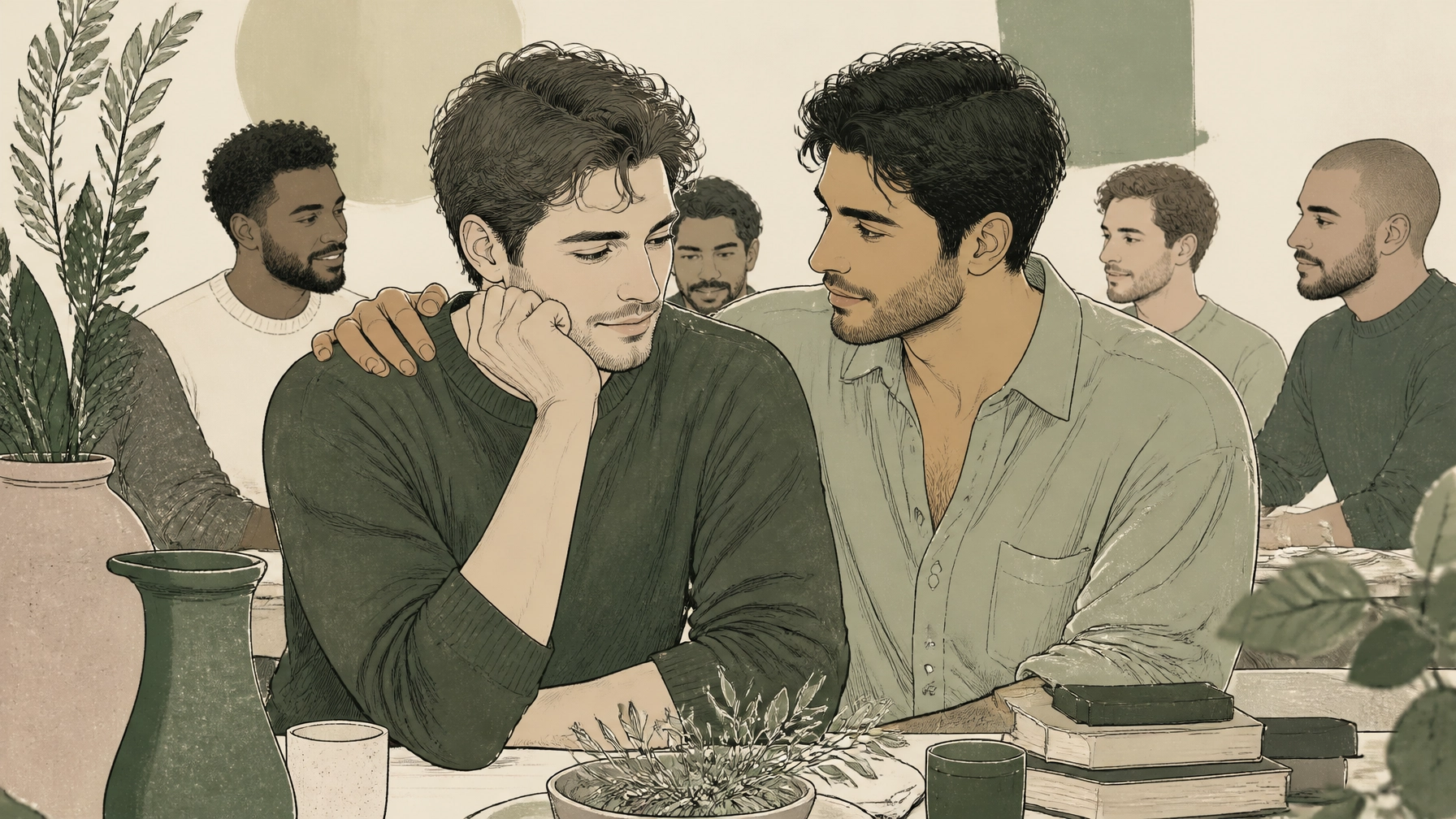
Eli first noticed the joke because everyone laughed except him.
It was a Friday evening, and Marcus’s flat was crowded with the familiar noise of male voices, clinking glasses, and music turned low enough for conversation. His partner’s friends had gathered around the kitchen island, arguing about a film none of them had actually finished watching.
Eli stood beside Marcus, one hand resting lightly against the small of his back.
“You’re basically one of us now,” Noah said, raising his glass towards Eli. “Marcus has completed your gay conversion.”
Daniel laughed. “No, no. Eli graduated. There should be a certificate.”
“Finally chose a side,” Noah added.
The laughter moved around the room like a wave. It reached Eli, touched him, and passed through.
Marcus squeezed his waist.
It was meant to be affectionate. Maybe even reassuring. But Eli felt the words settling somewhere beneath his ribs.
He was bisexual.
Not formerly bisexual. Not bisexual until he met Marcus. Not bisexual in theory while living a gay life in practice.
Bisexual.
He had spent years learning how to say the word without apologising for it. He had said it to Marcus on their third date, quietly, in the soft darkness of a cinema car park. He had waited for the familiar pause, the calculation, the suspicion.
Marcus had only taken his hand.
“Thank you for telling me,” he had said.
That moment had felt like a door opening.
Tonight, it felt as though someone had started closing it.
The Difference Between Being Included and Being Understood
Eli tried to join the conversation. He asked Daniel about work, laughed when Noah retold a story he had already heard, and helped Marcus carry plates through to the living room.
But the word graduated kept returning.
It appeared in different forms, always disguised as affection.
“You’re lucky Marcus rescued you from the bisexual waiting room.”
“Don’t worry, we won’t make you sit with the straight people.”
“You can stop keeping your options open now.”
None of them sounded cruel enough to challenge without appearing oversensitive. That was part of the problem. There was no single insult to hold up and say, There. That is the wound.
There were only small cuts.
Eli understood that Marcus’s friends had not invented these jokes from nowhere. Their humour had grown out of years of protecting one another. They had endured people who treated gay relationships as experimental, temporary, or less real. They knew what it was like to have their identities questioned by strangers.
Perhaps they thought they were reclaiming the language.
Perhaps they had convinced themselves that bisexuality was different because Eli was now in a relationship with a man.
But their history did not make the joke harmless. Pain could explain a person’s assumptions without excusing them.
And Eli’s identity did not become simpler just because his relationship looked, from the outside, like something everyone in the room understood.
Later, while Marcus washed glasses, Eli stood in the hallway with his coat folded over one arm.
“You’re leaving?” Marcus asked.
“I’m tired.”
“You barely ate.”
“I know.”
Marcus dried his hands and came towards him. “Did something happen?”
Eli almost said no. The answer had become automatic in rooms where belonging felt conditional.
Instead, he looked at Marcus.
“They keep talking as if being with you proves they were right about me.”
Marcus’s face changed: not dramatically, but enough. His mouth tightened. His eyes moved towards the living room, where Noah and Daniel were still talking.
“They were joking.”
“I know.”
“I don’t think they meant anything by it.”
“That’s what makes it difficult.”
Marcus leaned against the wall. “Are you saying you don’t want to be around them?”
“I’m saying I don’t know what I’m supposed to be around them as.”
The question stayed between them.
As Marcus’s bisexual partner? As a gay man by association? As someone who had finally selected the acceptable answer?
Eli lowered his voice. “I don’t want to be treated like I’m visiting a community that belongs to you. I don’t want to pass some test because I’m dating a man.”
Marcus looked down at the floor.
For a moment, Eli saw how easy it would be for him to become defensive. Marcus could say that Eli was included, that everyone liked him, that the jokes were nothing. He could list all the invitations, the shared meals, the messages in the group chat.
But inclusion was not the same as being understood.
“You’re right,” Marcus said.
Eli blinked.
Marcus rubbed his thumb over the edge of his phone. “I’ve been laughing because I thought it meant they accepted you. Like they were claiming you.”
“Claiming me?”
“You know what I mean.”
“I do. That’s the problem.”
The Intimate Things We Say When the Door Is Closed
They left soon afterwards.
Outside, the night air was cold enough to sharpen every thought. Marcus walked beside Eli without touching him until they reached the corner. Then he reached for Eli’s hand.
Eli let him take it.
At home, neither of them turned on the main lights. The flat filled with the muted glow of the street outside. Marcus changed into an old T-shirt while Eli sat at the edge of the bed, watching him move through the familiar room.
There was tenderness in the ordinary things: Marcus folding his jeans over a chair, Eli setting two glasses of water on the bedside table, their shoulders brushing as they passed.
“I don’t want you to feel like you have to defend me every time,” Eli said.
“I should have defended you tonight.”
“Yes.”
Marcus sat beside him. “I’m sorry.”
Eli studied his face. “Are you sorry because I’m upset, or because you understand what they were doing?”
“Both. But I’m beginning with the second one.”
That answer, imperfect as it was, made something in Eli loosen.
Marcus touched his knee. “Tell me what you needed me to say.”
Eli looked down at their hands.
“I needed you to say that being with you hasn’t changed who I am. That I don’t have to become more gay to be loved by you.”
Marcus’s fingers tightened around his.
“You don’t,” he said.
The words were simple. They did not repair every careless comment. They did not erase the old fear that Eli was somehow too complicated to be chosen. But they landed with enough weight to matter.
Marcus leaned forward and rested his forehead against Eli’s.
“I love you as you are,” he whispered. “Not as a version of you that makes everyone else comfortable.”
Eli closed his eyes.
When Marcus kissed him, it was slow and unhurried. There was no attempt to turn the moment into a solution. Their intimacy was not a grand declaration or a dramatic reconciliation. It was the quiet reassurance of two men staying present with one another.
Eli felt Marcus’s hand slide beneath his shirt, warm against his back. He felt the familiar steadiness of his breathing. He felt wanted: not categorised, not explained, not absorbed into someone else’s identity.
Just wanted.
For the first time that evening, Eli allowed himself to rest.
Finding a Seat at the Table
The next morning, Marcus messaged the group chat.
He did not write an essay. He did not expose Eli’s private feelings or ask him to prove the impact of what had happened.
He wrote:
Last night’s jokes about Eli “graduating” or choosing a side weren’t okay. He is bisexual. Being with me doesn’t make him gay, and he shouldn’t have to be treated as a guest in queer spaces. I laughed along, and I shouldn’t have. I’m sorry, Eli.
Eli read the message twice.
Then Noah replied.
You’re right. I thought I was being welcoming. I can see now that I was turning his identity into a punchline.
Daniel took longer.
I’m sorry too. I’ve spent so long assuming bisexual men are eventually going to call themselves gay that I stopped hearing what people actually tell me. That’s on me.
There was no sudden transformation. No perfect speech that made everyone wiser by lunchtime.
Noah asked Eli if he would be willing to talk about it, but added that he did not expect Eli to educate the whole group. Daniel said he would understand if Eli needed distance. Marcus listened rather than managing the conversation for him.
A week later, they met again: this time at a café, not Marcus’s flat.
Eli arrived first. For a moment, he considered choosing a table near the exit. Then he noticed Marcus waving from the back, with an empty chair beside him.
Not a seat that had been granted.
A seat that had been kept.
Noah stood when Eli approached.
“Can I say something?” he asked.
Eli nodded.
“I’m trying to learn the difference between welcoming someone and rewriting them so I know where they fit.”
Eli appreciated that Noah did not say he had changed forever. He was talking about a practice, not a performance.
“Thank you,” Eli said. “I’m still figuring out what I need too.”
“That’s fair.”
They sat down.
The conversation moved carefully at first, but it moved. Daniel asked Eli about a book he had been reading. Noah made a joke that was actually funny. Marcus reached beneath the table and brushed his fingers against Eli’s.
This time, when Eli looked around, he did not wonder whether he was being tolerated.
He wondered what it might feel like to belong without having to disappear first.
A Short Reflection
This gay love story emotional journey is about more than a disagreement between friends. It explores how bisexual representation can be undermined when a person’s identity is measured against his current relationship. Eli’s love for Marcus is real, but it does not replace his bisexuality. A man can be deeply committed to another man and still remain fully, honestly bisexual.
For emotionally invested MM readers, these quieter conflicts can carry as much weight as a dramatic external threat. The most powerful character-driven queer fiction often lives in the moments when a character asks whether love requires him to become easier to understand.
That question sits at the heart of emotional MM romance literary storytelling: how do two men build a relationship that makes room for the whole truth of who they are?
At Read with Pride, readers can discover LGBTQ+ ebooks, gay books, MM romance, gay romance, queer fiction, gay fiction, MM novels, and LGBTQ+ fiction that explore identity with emotional honesty. Stories about bi visibility and bisexual representation matter because they remind us that queer lives do not have to fit a single shape.
The best MM romance unexpected places can begin with a kiss, a difficult conversation, a crowded kitchen, or the moment someone finally realises that belonging should not require self-erasure.
Read with Pride
Explore Dick Ferguson’s emotionally immersive LGBTQ+ ebooks and discover more gay love stories, character-driven MM novels, and heartfelt queer fiction through Read with Pride.
Browse the available books in the Dick Ferguson collection at Read with Pride.
Three Fresh Ideas for the Next Instalment
-
When His Boyfriend’s Family Calls Their MM Relationship “A Phase” : A bisexual man confronts the difference between private acceptance and public respect when his partner’s relatives assume their relationship cannot last.
-
The Gay Bar Where He Is Too Bi for the Regulars and Too Queer for Strangers : Two men navigate the exhaustion of being repeatedly asked to prove which part of an identity is real.
-
When His Partner Wants a Simple Label and He Needs Room to Breathe : An MM couple faces the fear that loving someone deeply can still bring complicated questions about language, visibility, and trust.
Follow Us on Social Media
Follow Dick Ferguson for more emotionally immersive MM romance, LGBTQ+ fiction, gay literature, and reading recommendations:
#ReadWithPride #Readwithpride #MMRomance #GayRomance #BisexualRepresentation #BiVisibility #QueerFiction #GayFiction #LGBTQPlusFiction #MMNovels #EmotionalMMRomance #CharacterDrivenFiction #QueerLoveStories #LGBTQReading


Leave a Reply
You must be logged in to post a comment.