

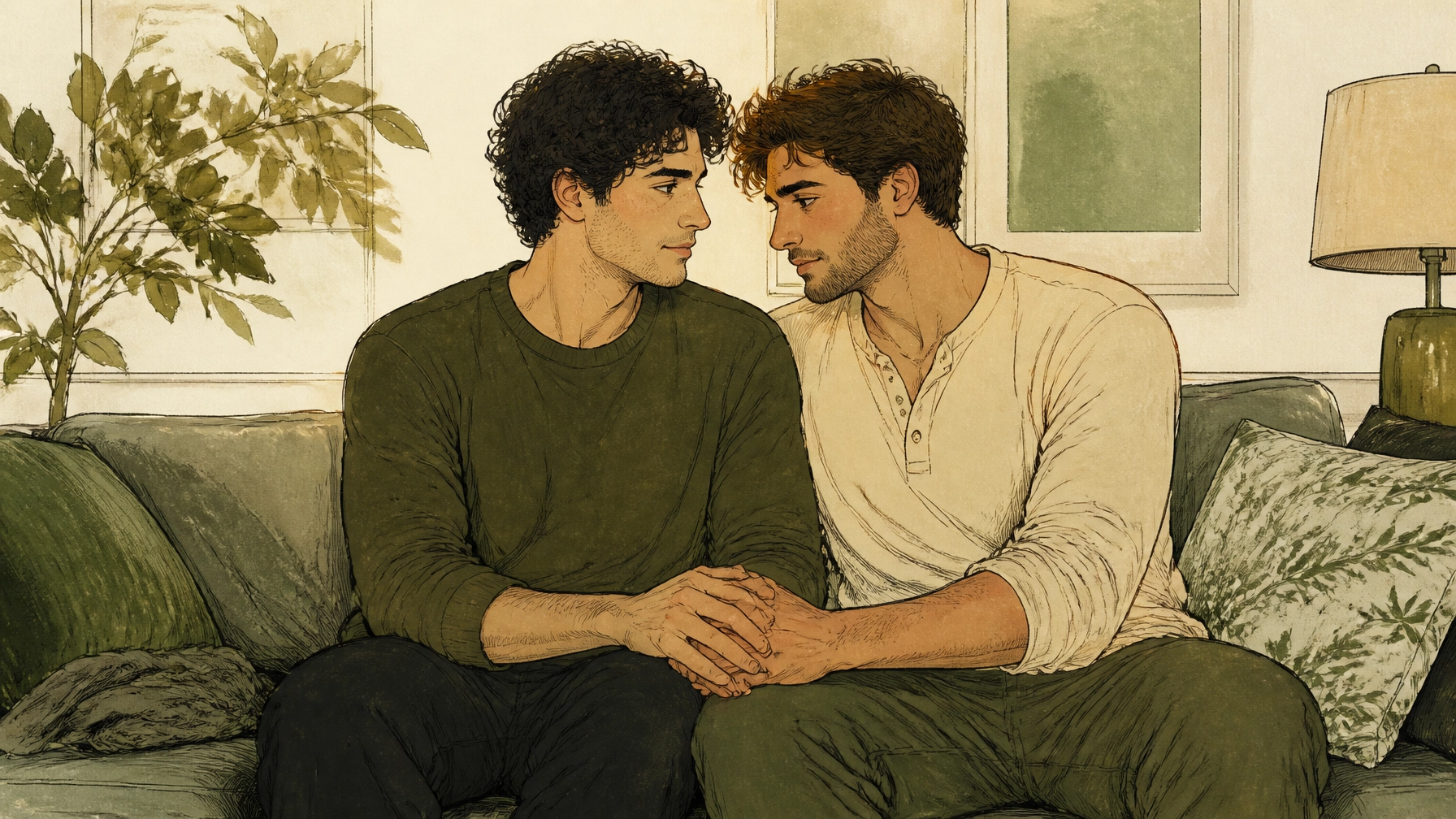
The Sentence That Stayed in the Room
Caleb heard Marcus say it while they were washing up after dinner.
“I don’t see labels,” Marcus said. “I just see us.”
He said it gently. That was almost the hardest part.
There was no sharpness in his voice, no obvious judgment. Marcus wasn’t trying to dismiss Caleb. He was trying to be reassuring, trying to say that their relationship mattered more to him than categories, assumptions, or the opinions of other people.
But Caleb stood with his hands beneath the running tap, watching the water carry a curl of soap towards the drain.
“I know you mean that kindly,” he said.
Marcus turned off the tap. “But?”
Caleb dried his hands slowly. He had spent years learning how to name himself. Not perfectly, and not always without fear, but honestly. Bisexual had become more than a word he used when someone asked him to explain himself. It had become a small, steady place to stand.
“I am bisexual,” Caleb said. “That label isn’t a cage for me. It’s a way of telling the truth.”
Marcus leaned against the counter, his expression changing. The warmth in his face gave way to concern.
“I’m not trying to take that away.”
“I know.”
“And I love you as you are.”
“I know that too.”
The problem was that love, by itself, did not always prevent someone from becoming invisible.
When Acceptance Still Misses the Point
Marcus had never told Caleb that bisexuality was a phase. He had never suggested Caleb was confused or secretly gay. He had never asked him to prove anything.
In fact, Marcus thought he was doing the opposite of those things. He believed that saying he did not see labels meant Caleb could relax. Their relationship was real, and that was what mattered. Marcus did not want Caleb to feel reduced to a category.
But Caleb had heard versions of this before.
He had heard people describe him according to whoever he was dating. Before Marcus, when Caleb dated a man, some people called him gay. When he had dated someone of another gender, people assumed he was straight. The word bisexual seemed to disappear whenever someone found a simpler explanation.
It was as though his identity had to change shape to fit the relationship other people could see.
“I don’t need you to see me as a label instead of a person,” Caleb said. “I need you to understand that bisexual is part of who I am. It doesn’t replace me. It helps describe me.”
Marcus looked down at the kitchen floor.
“I thought labels were the problem.”
“They can be,” Caleb said. “When people force them onto you. When they decide what you are without listening. But choosing a label for yourself can be different. Sometimes it gives you language for something you’ve carried alone.”
The distinction was small in wording and enormous in feeling.
There was a difference between saying, “I don’t use labels for myself,” and saying, “I don’t recognise the label you use for yourself.”
The first could be personal freedom.
The second could become erasure.
A Conversation Without Defensiveness
Marcus did not rush to explain himself. He did not say Caleb was being too sensitive. He did not insist that his intentions should settle the matter.
Instead, he asked, “When I say I don’t see labels, what do you hear?”
Caleb took a breath.
“I hear that the word bisexual makes you uncomfortable. Or that you think it’s unnecessary now that I’m with you. I hear that our relationship is acceptable to you as long as you don’t have to make room for the whole of me.”
Marcus’s face tightened.
“That isn’t what I want.”
“I know. But sometimes what we mean and what someone hears are different. Especially when the thing being discussed has been ignored before.”
Marcus reached across the space between them. He did not grab Caleb’s hand. He waited.
After a moment, Caleb placed his hand in Marcus’s.
“I don’t want you to be defined only by the fact that you’re gay,” Caleb said. “I love you as a whole person. But I would never tell you that your identity was too limiting, or that I preferred not to notice it. I want the same care from you.”
Marcus turned Caleb’s hand over and traced the lines in his palm.
“What would honouring it look like?”
The question loosened something in Caleb’s chest.
“It might mean correcting people when they assume I’m gay because I’m with you. It might mean not treating my past as irrelevant. It might mean understanding that being bisexual doesn’t make me less committed to you.”
Marcus nodded.
“And if I say I don’t use labels for myself?”
“Then I’ll respect that,” Caleb said. “As long as you respect that I do.”
The answer was not dramatic. No music rose in the background. Nothing was magically repaired in a single conversation.
But Marcus listened.
Sometimes that is where repair begins.
The Identity That Remains
Later, they sat by the open window while evening gathered between the buildings. Marcus rested his head against Caleb’s shoulder.
“I’m sorry,” he said.
Caleb looked at him. “For what?”
“For making my version of acceptance more important than your experience.”
Caleb felt the words settle gently.
Marcus continued. “I thought if I said I didn’t see labels, I was telling you that nothing about you could make me love you less. But I can see now that I was also making the word disappear. I was deciding that not noticing was the kindest thing.”
“Sometimes being seen is kinder.”
Marcus kissed his temple.
“Then I see you.”
Caleb smiled, though his eyes had begun to sting.
“I’m bisexual,” he said.
“I know.”
“I’m also your boyfriend.”
“I know that too.”
The two truths sat beside each other without competing. Caleb did not have to choose between them. He did not have to make his identity smaller to reassure Marcus. Marcus did not have to understand every part of bisexuality immediately. He only had to remain willing to listen, learn, and believe Caleb when Caleb described his own life.
That was the difference between ignoring identity and honouring it.
Ignoring says: I don’t want to notice the word.
Honouring says: I will let you choose the words that help you tell the truth about yourself.
For Caleb, the label was not a wall between him and Marcus. It was a door he had finally learned how to open.
And Marcus, standing beside him, chose not to close it.
Short Reflection
A meaningful gay love story emotional journey does not have to rely on a dramatic betrayal to explore conflict. Sometimes the most painful misunderstandings grow from words intended to comfort. In this story, Caleb and Marcus discover that emotional intimacy requires more than affection. It requires the willingness to understand how identity shapes a person’s history, fears, and sense of belonging.
This is the heart of character-driven queer fiction: allowing characters to be more complicated than the labels other people place on them. Caleb is bisexual and in a committed relationship with a man. Those truths do not cancel each other out. Marcus is gay, and his identity is not threatened by Caleb’s bisexuality. Their relationship becomes stronger when both men are allowed to exist fully within it.
For emotionally invested MM readers, this kind of conflict can feel especially familiar. The question is not whether love is present. The question is whether love makes room for honesty. In emotional MM romance literary fiction, a quiet conversation can carry as much weight as a grand declaration because the characters are working through the stories they have been told about themselves.
Sometimes an MM romance in unexpected places begins with an unexpected lesson: acceptance is not simply refusing to judge someone. It is learning to recognise the identity they have chosen, even when you would describe yourself differently.
If you enjoy heartfelt gay fiction, emotional MM books, LGBTQ+ fiction, gay love stories, and character-led MM novels, you can explore more stories through Read with Pride. You can also find Dick Ferguson’s work in the Dick Ferguson e-book store on Read with Pride.
Three Fresh Ideas for the Next Instalment
-
When His Boyfriend Says He Is “Too Open” About Being Gay
Two men confront the difference between privacy and shame when one partner worries that the other’s openness will change how people see them. -
When His Boyfriend’s Old Friends Refuse to Believe He Is in Love
A gay man’s friends treat his committed relationship as a temporary experiment, forcing the couple to decide which voices deserve space in their future. -
When His Boyfriend Wants to Come Out but Is Afraid of Losing His Best Friend
An MM couple navigate fear, loyalty, and the painful uncertainty of waiting for someone else to accept the truth.
Follow Us on Social Media
Follow Dick Ferguson for more emotionally immersive queer fiction, gay romance books, MM romance, LGBTQ+ ebooks, and new stories about love, identity, vulnerability, and resilience:


#QueerFiction #MMRomance #GayRomance #BisexualVisibility #BiRepresentation #LGBTQBooks #ReadWithPride #ReadingWithPride #LGBTQFiction #GayBooks #MMFiction #GayLoveStories #EmotionalMMBooks #CharacterDrivenFiction

Leave a Reply
You must be logged in to post a comment.