

Content note: This article discusses grief, bereavement, family estrangement, community loss, and emotional healing. Please take what feels useful and leave what does not.
Grief does not always arrive with a clear beginning or a tidy ending. Sometimes it follows a death or the end of a relationship. Sometimes it is the ache of losing family support, a home, a community, a sense of safety, or the future you once thought you were going to have.
For LGBTQ+ people, grief can carry extra layers. We may be mourning someone who did not accept our identity, a relationship that was never publicly acknowledged, a chosen family member who has moved away, or the younger self who deserved more kindness. We may also be grieving collectively: after violence, discrimination, political setbacks, or the loss of queer spaces that once helped people feel less alone.
That is why queer healing is not about pretending everything is fine. It is about making room for the whole truth: the hurt, the anger, the tenderness, the memories, and the possibility that something beautiful can still grow.
Grief is not a failure to move on
There is a lot of pressure to “move forward” as if healing were a race with a finish line. But grief is rarely that cooperative. It may disappear into the background for a while, then reappear because of a song, a date, a family gathering, or a completely innocent supermarket aisle.
You are not going backwards when a difficult day arrives. You are having a human response to something that mattered.
Queer grief can also be disenfranchised grief: loss that other people refuse to recognise or understand. Perhaps someone dismisses your former partner because your relationship was not traditional. Perhaps relatives exclude your chosen family from decisions or rituals. Perhaps people use the wrong name or pronouns for someone you loved.
That kind of invalidation can make grief feel lonely twice over. The loss hurts, and then you are expected to prove that the loss was real.
It was real.
Your relationship was real. Your love was real. Your memories are real. You do not need permission from someone else to mourn.
Research and support organisations such as Eluna Network and Evermore highlight how LGBTQ+ people can face unique barriers around bereavement and chosen family. Naming those barriers is not dwelling on the past. It is one way of beginning to heal.

Chosen family can be part of the medicine
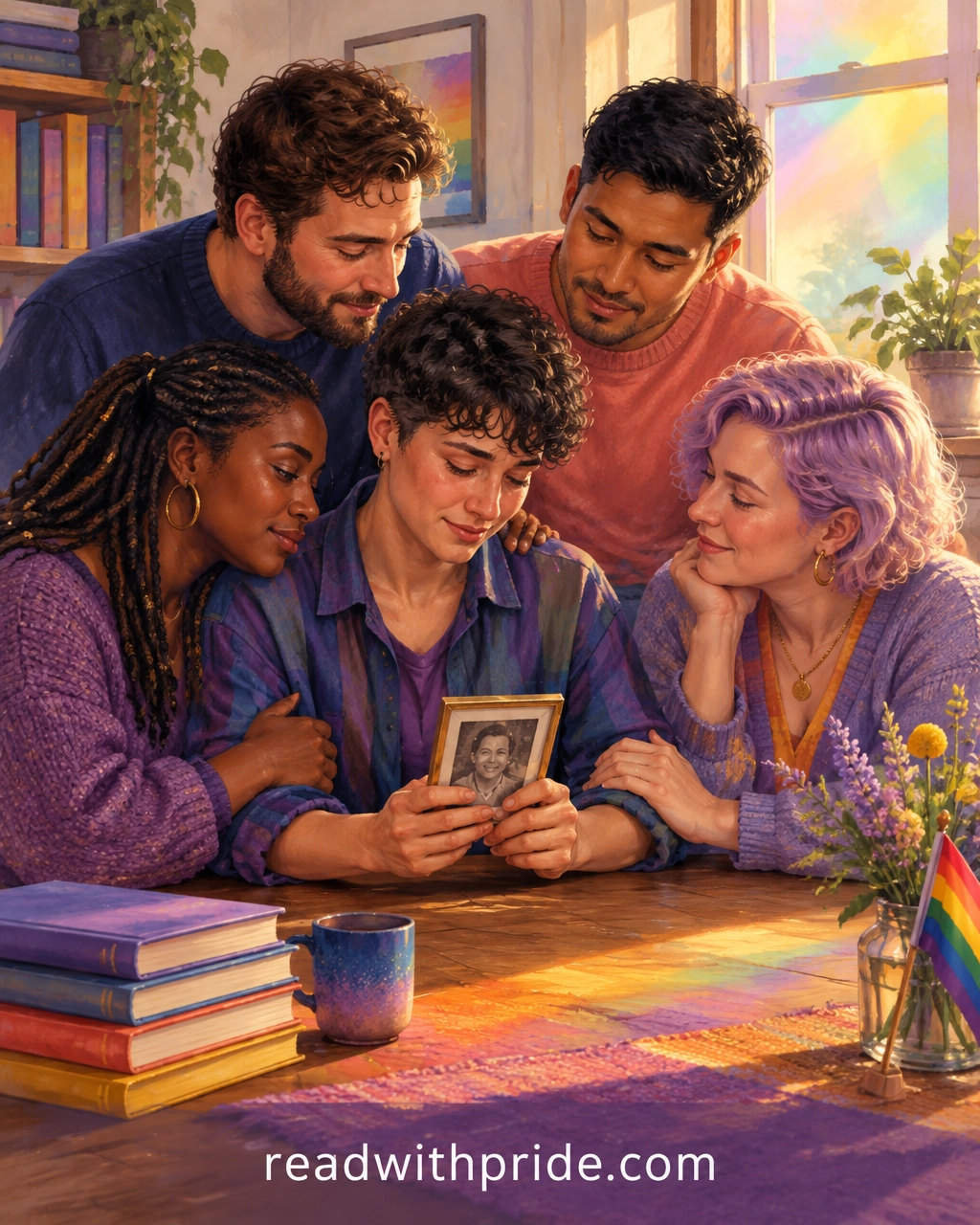
Chosen family is not a consolation prize. For many LGBTQ+ people, it is where love becomes practical.
It is the friend who knows when to bring food instead of asking, “What do you need?” It is the ex who still checks in. It is the neighbour who learns your pronouns and remembers the anniversary. It is the queer book club that makes room for silence, snacks, and an unexpectedly passionate discussion about fictional men who desperately need to communicate.
Community does not erase grief, but it can make grief less isolating.
Support might look like:
- Creating a small remembrance ritual with people who understand the relationship you lost.
- Asking friends to use the name and pronouns that feel right when talking about someone who has died.
- Joining an LGBTQ+-affirming grief group online or locally.
- Making a memory box, playlist, scrapbook, or shared digital album.
- Setting boundaries with people who minimise your loss.
- Letting someone sit beside you without requiring a performance of progress.
The QueerCircle grief programme offers LGBTQ+-focused spaces for conversations about death, loss, and mourning. In the UK, Switchboard’s Grief Project connects LGBTQ+ people with peer support and listening resources. These are not replacements for professional care, but they can be meaningful starting points.
Small acts of queer healing count
Healing is often less dramatic than we expect. It may be getting dressed. Drinking water. Answering one message. Taking a walk around the block. Cooking something with actual vegetables rather than assembling an emotionally significant plate of toast.
Small acts matter because grief affects the body as well as the mind. Rest, food, movement, routine, and connection can help create a little more steadiness when everything feels uncertain.
You might try asking yourself:
- What would make the next hour slightly gentler?
- Who makes me feel seen rather than managed?
- Is there a boundary I need today?
- What memory can I hold without forcing myself to feel cheerful?
- What would I say to my younger queer self if they were sitting beside me?
There is no single correct healing practice. Some people find comfort in therapy or support groups. Others prefer creative rituals, spiritual practice, time in nature, or quiet companionship. The goal is not to become a perfectly healed person. The goal is to remain connected to yourself while you move through something difficult.
If grief is affecting your safety or you are worried you may harm yourself, contact local emergency services or a crisis service in your country. For LGBTQ+ young people in the US, The Trevor Project provides crisis support. Trans people can find peer support through Trans Lifeline. UK readers can contact Switchboard for LGBTQ+-affirming listening support and information.
Hope is not betrayal
One of the hardest things about grief is the fear that joy means forgetting.
You laugh and feel guilty. You make plans and wonder whether you are leaving someone behind. You fall in love again, start a new project, or imagine a different life, and part of you asks whether hope is somehow disloyal.
It is not.
Joy does not cancel grief. Hope does not rewrite history. A future filled with love can exist alongside a past filled with loss.
This is where future visions become powerful. Imagining a hopeful queer future does not mean ignoring the people and struggles that brought us here. It means asking what their courage makes possible.
What might a future look like where every queer person has a safe place to grieve? Where partners and chosen family members are recognised without argument? Where LGBTQ+ elders are remembered with respect? Where young people grow up surrounded by affirming adults, honest education, and stories that do not treat their identities as problems to solve?
The answer begins in small places: a friend’s kitchen, a community centre, a shared book, a supportive message, a story that lets someone recognise themselves.

Stories help us imagine what comes next
Queer fiction cannot cure grief, but it can give grief language. It can show us people surviving difficult chapters without becoming defined by them. It can remind us that love is not limited to one shape, one timeline, or one ending.
At Read with Pride, our collection of LGBTQ+ ebooks includes gay fiction, LGBTQ+ novels, queer love stories, lesbian romance, and emotionally rich stories about identity, belonging, and starting again. Readers may arrive looking for MM romance books or gay romance novels, but they often stay for the wider sense of possibility: stories where queer characters get to desire, argue, heal, build families, grow older, and imagine a future.
That includes coming out stories, gentle relationship narratives, bold LGBTQ+ fiction 2026, and books that make space for complicated feelings. It also includes the everyday pleasure of finding a story that says, “You are not the only one.”
Whether you are browsing gay fiction, looking for LGBTQ+ novels, planning a queer book club discussion, or searching for a hopeful read after a difficult week, stories can become a form of companionship.
And yes, that includes the full range of queer reading interests: from MM romance books and gay romance novels to lesbian romance, bisexual stories, trans fiction, and the occasionally mysterious search term C Section 2026. The point is simple: queer readers deserve room to be curious, emotional, romantic, funny, messy, hopeful, and entirely themselves.
A future worth reaching for
Queer resilience is not the expectation that we should endure everything without support. Resilience can mean resting. Asking for help. Telling the truth about what happened. Refusing to let someone else shrink your love into something more convenient.
Sometimes resilience is simply remaining open to another morning.
The future does not need to be perfect to be worth imagining. It can be ordinary and wonderful: a home where your partner’s name is welcomed, a community garden where nobody has to explain themselves, a book club full of people who understand why the ending made everyone cry, a quiet afternoon where grief sits beside you without taking up every seat.
If you are grieving, go gently. If you are supporting someone who is grieving, listen without trying to tidy their feelings. If you are able, help build the kind of queer future where every loss is recognised and every person is allowed to heal in their own way.
For more LGBTQ+ reading, visit readwithpride.com, explore the latest Read with Pride blog posts, and share your favourite queer love stories with someone who might need them today. You can also follow Read with Pride on Instagram and Facebook.
Hope is not pretending the grief never happened.
Hope is believing that grief is not the only thing that gets to decide what happens next.
#ReadWithPride #QueerHealing #FutureVisions #LGBTQResilience #QueerFiction #LGBTQBooks #MMRomanceBooks #GayRomanceNovels #ChosenFamily #QueerLoveStories #LGBTQFiction2026

Leave a Reply
You must be logged in to post a comment.