

Content note: This article discusses grief, partner loss, family rejection, estrangement, hidden years, community loss, and emotional healing. Please take what feels supportive and leave anything that feels too close today.
There is a strange and beautiful thing about imagining yourself as a queer elder.
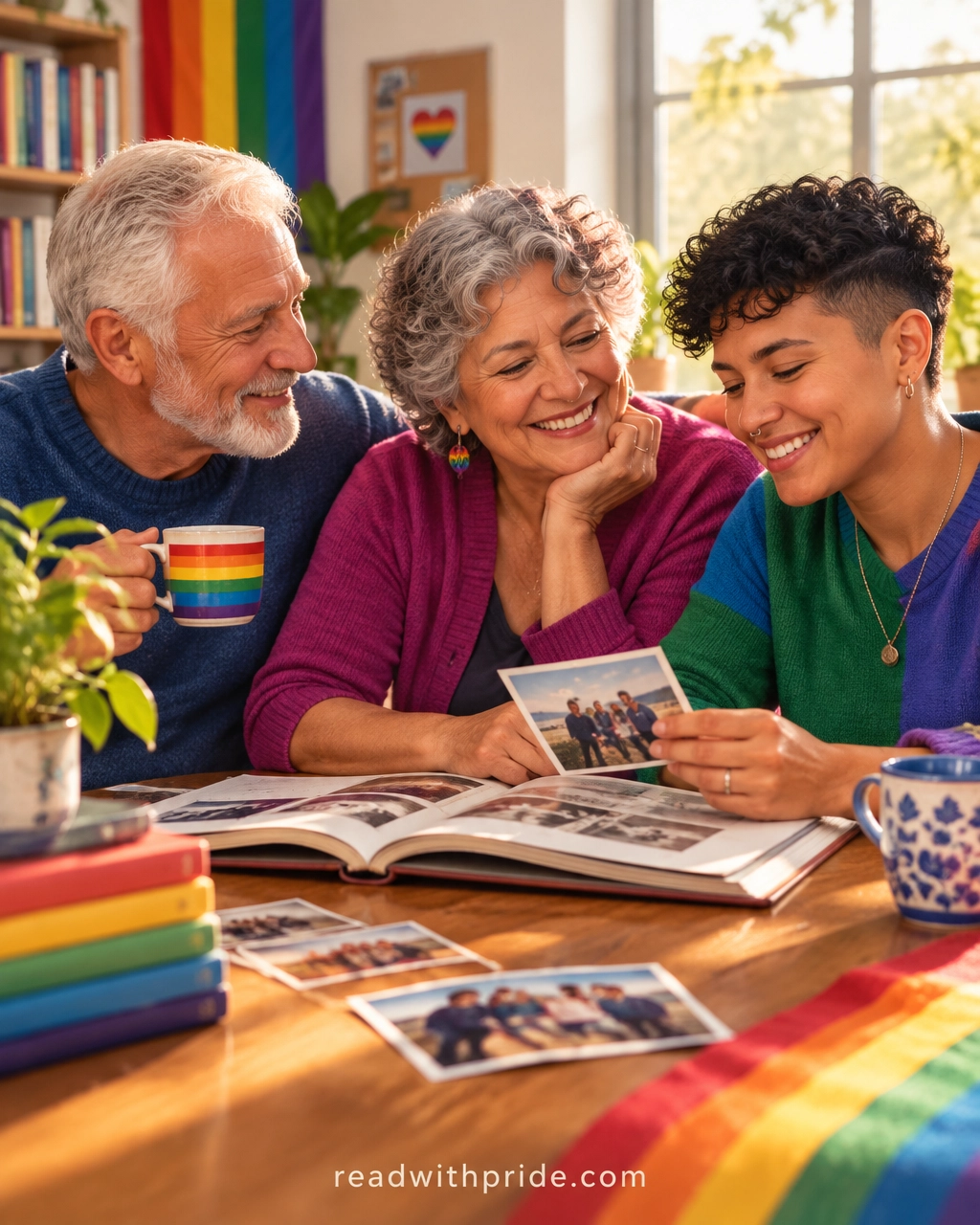
For some of us, the image arrives easily: silver hair, excellent stories, a home full of plants, and an absolutely unreasonable number of books. For others, it takes more work. Growing older as an LGBTQ+ person has not always been presented as a joyful possibility. Many of us were taught, directly or indirectly, that queer life was temporary, dangerous, lonely, or destined to end before it really began.
And yet here we are.
We are growing older. We are caring for queer elders now. We are becoming the people younger LGBTQ+ people may one day look toward for reassurance, context, humour, and proof that a full life is possible.
That is the heart of queer healing and future visions: making room for grief without allowing it to become the only future we can imagine.
The queer elders who made it possible to be here
Queer elders are not a single group with one shared story. Some lived openly for decades. Some spent years carefully editing their lives around hostile families, workplaces, churches, neighbours, or laws. Some found love late. Some lost partners without being recognised as next of kin. Some built chosen families from scratch. Others never had the safety or language to name what they needed.
Their lives may include joy, but they may also include hidden years.
Those hidden years matter. So do the compromises people made to survive. A person who stayed closeted at work may still have been brave. Someone who never told their family may still have loved deeply. Someone who did not find a long-term partner may still have built a rich, connected life.
LGBTQ+ resilience is not a competition for the most dramatic survival story. It is not about being endlessly strong, grateful, cheerful, or available to everyone else. Sometimes resilience looks like speaking up. Sometimes it looks like resting. Sometimes it looks like deciding that you will not explain your relationship to one more person who has already chosen not to understand it.
Queer elders deserve more than our admiration for what they endured. They deserve care, privacy, pleasure, accessible housing, affirming healthcare, and the freedom to remain fully themselves.
Caring for queer elders now
Caring for an LGBTQ+ elder can involve practical support: lifts to appointments, help with paperwork, shopping, meals, medication, or a hand on the shoulder during a difficult conversation. It can also involve something less visible but just as important: making sure their queer history is not erased.
Ask about the people they loved.
Ask what names they used, what communities held them, which songs take them back, and what they had to learn the hard way. If a partner has died, do not assume that grief is simple because the relationship was not formally recognised. A person can lose a lifelong love and still find themselves explaining why the loss matters.
Partner loss in LGBTQ+ communities may carry additional layers: complicated legal arrangements, strained relationships with a partner’s relatives, missing photographs, or the pain of being treated like “just a friend.” Grief can also come from family rejection, estrangement, lost friendships, closed venues, communities changed by illness, or the slow disappearance of people who once made a city feel like home.
Care begins with listening without rushing to tidy the story.

Grief belongs in our future visions
Optimism is not the same as pretending everything is fine.
A hopeful queer future must have room for mourning. It must make space for the person who is still grieving a parent’s rejection, a former partner, a lost friend, a body that changed, a home that was unsafe, or a version of life they were told they could never have.
Queer healing is rarely a straight line. You may feel peaceful in the morning and furious by lunchtime. You may celebrate your chosen family while still longing for acceptance from your original one. You may be deeply loved and still carry loneliness from earlier years.
None of this means you are failing to heal.
It may mean you are healing honestly.
Stories can help because they give shape to feelings that are otherwise difficult to hold. The best gay fiction, LGBTQ+ novels, and queer love stories do not insist that every wound disappear before the happy ending. They allow characters to carry history into love. They let tenderness exist beside anger, desire beside fear, and hope beside loss.
That is one reason queer reading matters at every age. A novel cannot replace community care, but it can offer language, recognition, and a quiet sense that somebody else understands the emotional weather.
You can explore Read with Pride’s LGBTQ+ fiction collection or browse LGBTQ+ romance and MM romance books when you want stories centred on connection, identity, desire, and survival.
Becoming the elders we needed
Many of us grew up without enough queer elders in our immediate lives. Perhaps we had no openly LGBTQ+ teacher, neighbour, relative, doctor, or mentor. Perhaps we had public figures but no one who could show us the ordinary details: how to build a home, repair a friendship, grow old with a partner, start again after heartbreak, or be queer on a boring Tuesday.
Now we have the chance to become some of those people for one another.
This does not mean becoming a perfect role model. Please, no. The queer community has enough pressure to perform wisdom while exhausted.
It means being honest about the road behind us. It means telling younger people that coming out stories do not all have to end in reconciliation. It means showing that there are many ways to build a life: partnership, friendship, parenting, activism, art, solitude, community work, travel, spirituality, ridiculous hobbies, and staying home with a book because the outside world is doing too much.
It means sharing knowledge without turning it into a test.

A queer elder might be sixty-five. They might be thirty-eight and the most experienced person in the room. They might be the friend who knows how to navigate a difficult family gathering, the neighbour who checks in after surgery, or the auntie who always has snacks and a spare charger.
Age matters, but so does accumulated care.
A gentle reflection for today
This is not homework. There will be no marking, and nobody is checking whether you have journaled correctly.
If it feels useful, take a quiet moment with these questions:
-
Who helped me imagine a queer future?
This could be a person, a story, a community, or even a fictional character. -
What do I wish a queer elder had told me earlier?
Write the sentence exactly as you would have needed to hear it. -
What kind of elder am I becoming?
Consider the qualities you want to offer: humour, patience, practical help, honesty, protection, curiosity, or a well-stocked biscuit tin. -
What is one small form of care I can offer now?
Send a message. Share a meal. Ask about someone’s partner. Listen to a story you have heard before. -
What would a hopeful queer future make ordinary?
Maybe it is an affirming care home. A queer book club where nobody is isolated. Healthcare that recognises chosen family. Families who do not treat LGBTQ+ love as an explanation requiring approval.
Future visions become more powerful when they include ordinary details.
A future with room for joy
The queer future we owe one another is not a glossy, painless paradise. It is a future where grief is taken seriously and nobody is reduced to their grief. It is a future where elders are not hidden away, younger people are not asked to carry everything alone, and care moves in every direction.
It is a future full of stories.
There is space for MM romance books, gay romance novels, lesbian romance, bisexual love stories, trans joy, coming-of-age narratives, steamy romance, quiet domestic fiction, and every form of queer fiction that helps us recognise ourselves or imagine beyond what we have known. There is space for LGBTQ+ fiction 2026, for new voices, for beloved rereads, and for the kind of queer book club conversation that begins with “I loved the ending” and ends three hours later with everyone discussing family, ageing, desire, and the meaning of home.
Even the wider reading landscape can be wonderfully varied: gay fiction, LGBTQ+ novels, queer love stories, coming out stories, and the occasional highly specific search such as C Section 2026. Queer lives have never fitted neatly into one shelf, and our reading does not have to either.

At Read with Pride, LGBTQ+ ebooks are part of that wider future: a place for emotional stories, romantic escapes, challenging ideas, and books that remind us our lives deserve to be documented in all their complexity.
Explore the LGBTQ+ ebooks and queer fiction collections, browse MM romance books and gay romance novels, or visit the LGBTQ+ blogs and articles section for more reflections on identity, relationships, healing, and community.
You can also follow Read with Pride on Facebook and Instagram for new reading recommendations and queer stories.
What future are you helping to build? Share one small vision of queer joy, care, or belonging, and then find a story on Read with Pride that helps you carry it forward.
#ReadWithPride #QueerHealing #FutureVisions #LGBTQResilience #LGBTQFiction2026 #MMRomanceBooks #GayRomanceNovels #QueerLoveStories #ComingOutStories #QueerBookClub #LGBTQBooks #QueerFiction

Leave a Reply
You must be logged in to post a comment.