

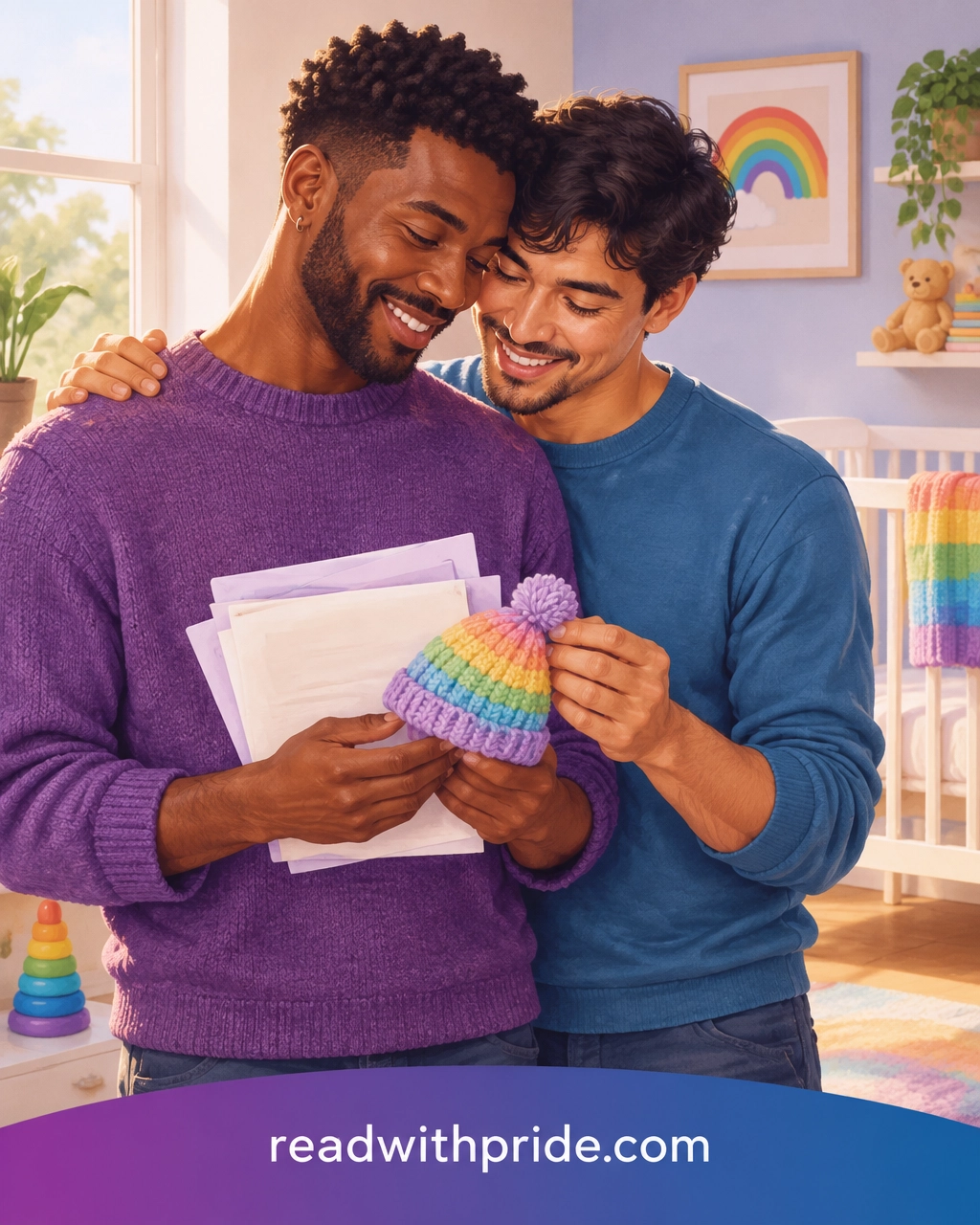
There is no single queer route to parenthood, and that is one of the most beautiful things about queer family life.
For some couples, becoming parents begins with a fertility appointment. For others, it starts with an adoption application, a foster-care training session, a conversation with a trusted donor, or the realisation that a child already in the family needs another person to show up consistently.
Sometimes it begins with a spreadsheet. Sometimes with a phone call. Sometimes with a very emotional trip to the baby aisle, followed by the mutual agreement that tiny socks are both adorable and financially suspicious.
In this instalment of our LGBTQ+ Relationships and Life Milestones series, we are looking at queer parenthood: the routes families take, the legal hoops and paperwork, the waiting, the uncertainty, the joy, and the people who help make a home feel like home.
Parenthood does not follow one timeline
Straight relationship timelines often present parenthood as a predictable next step: date, marry, buy a house, have children. Queer families have always known that real life is less tidy.
You may become a parent before marriage, after a long-term partnership, as a single person, through a blended family, or with co-parents who are not romantic partners. You may know from childhood that you want children, or discover the possibility later. You may change your mind more than once.
There is no “correct” order.
For LGBTQ+ people, becoming parents can also involve extra emotional work. You may need to ask whether a clinic, agency, school or court will recognise your family. You may have to explain your relationship repeatedly. You may be building a family while also carrying memories of rejection, complicated coming out stories, or the experience of creating a chosen family from scratch.
That history can make the milestone feel especially profound. You are not simply becoming a parent. You are deciding what kind of home, language and safety you want to create.
Adoption: paperwork, patience and a life-changing match
Adoption can take many forms, including domestic adoption, public-agency adoption, private adoption, international adoption and second-parent adoption.
For queer couples, the process may involve applications, references, background checks, financial records, interviews, home studies and training. The exact requirements depend on where you live and which route you pursue. Timelines can stretch from months to years, and the waiting period can be emotionally demanding.
Adoption is not a shortcut to parenthood, and it is important to approach it with care for the child’s history, identity and existing relationships. Prospective parents may need to prepare for trauma-informed parenting, openness with birth families, and the reality that love does not erase a child’s previous experiences.
For a non-biological parent, second-parent adoption or another parentage process may also be important. Even when both parents are deeply involved from the beginning, legal recognition is not always automatic. A family-law professional with experience in LGBTQ+ parentage can explain the rules in your jurisdiction.
The paperwork may be repetitive. The waiting may be frustrating. But each form can also represent something deeply hopeful: a home being prepared, a future being made possible, a child being welcomed with intention.
Fostering: parenting through care, flexibility and advocacy
Foster care is another meaningful path to queer parenthood. Foster parents provide temporary care for children and young people who cannot safely remain in their current homes. In some situations, reunification with birth family is the goal. In others, long-term fostering or adoption may become part of the plan.
Fostering usually involves licensing, training, background checks, home assessments and ongoing reviews. It can require flexibility around contact arrangements, appointments, school changes and the child’s emotional needs.
It also asks parents to hold complicated truths at once. You can love a child fiercely while understanding that your role may be temporary. You can create stability without assuming the story will end in adoption. You can advocate for a child while respecting the relationships and culture they bring with them.
Queer foster parents often bring valuable experience in navigating identity, difference and systems that do not always make room for everyone. But no parent should have to do this work alone. Support networks, knowledgeable professionals and affirming community matter.
Donor conception and reciprocal IVF
For many lesbian couples and queer people with access to fertility treatment, donor conception may involve intrauterine insemination, IVF, reciprocal IVF or at-home insemination.
Reciprocal IVF can allow one partner to provide the eggs while the other carries the pregnancy. It may create a shared biological connection, but the legal parentage position can still vary. The person who gives birth may be recognised automatically in some places, while the non-birth parent may need additional legal protection.
Known-donor arrangements can feel personal and community-rooted, particularly when a trusted friend is involved. They can also become complicated without clear agreements. Before conception, it is wise to discuss expectations around contact, decision-making, finances, medical information and legal parenthood with qualified legal and medical professionals.
The most important conversations are often the least romantic: Who is responsible for what? What happens if someone moves? Who makes healthcare decisions? How will the child understand their donor story?
Those conversations are not a lack of trust. They are a way of protecting everyone involved.

Surrogacy: a route shaped by contracts and careful planning
Surrogacy can be an important route for gay male couples, trans people and others who cannot carry a pregnancy or who need additional support to become parents.
Gestational surrogacy usually involves an embryo created using an egg donor and sperm from one or both intended parents, although arrangements vary. The surrogate does not have a genetic connection to the child in gestational surrogacy.
The process may involve fertility clinics, donor agreements, medical screening, contracts, insurance questions and pre-birth or post-birth parentage orders. Laws differ substantially between countries, regions and states. Some jurisdictions restrict or prohibit particular forms of surrogacy, while others have clearer pathways for intended parents.
This is one area where specialised legal advice is essential. A birth certificate alone may not provide every protection a family needs, particularly when travelling, moving or dealing with medical decisions. Parentage orders or adoption may be recommended depending on the circumstances.
Surrogacy can involve enormous joy, but it can also include failed cycles, financial pressure, medical uncertainty and long stretches of waiting. Hope and anxiety often sit side by side.
Co-parenting, step-parenting and the people who help raise children
Not every queer family is built by a romantic couple.
Co-parenting arrangements may involve friends, queerplatonic partners, two couples, or people who intentionally share parenting without being romantically involved. These families can be deeply loving and well-organised, but they benefit from honest conversations and written agreements about custody, finances, living arrangements, education and healthcare.
Blended families bring their own kind of tenderness. A partner may become a step-parent to a child from a previous relationship. A non-biological parent may already be doing the everyday work (school runs, bedtime stories, packed lunches and emotional support) before legal recognition catches up.
Step-parent or second-parent adoption may create additional security, but it is only one part of the relationship. Parenthood is also built through repetition: showing up, remembering the snack preference, attending the school event, and knowing exactly which stuffed animal is required for sleep.
And then there is chosen family.
The auntie who babysits. The friend who brings soup. The neighbour with the spare key. The grandparent-by-choice who knows how to calm a meltdown and never arrives empty-handed. Queer family life often depends on a wide circle of care, not because parents are inadequate, but because children thrive when they are surrounded by safe, loving adults.

The legal hoops are real, but so is the joy
Across adoption, fostering, donor conception, surrogacy and co-parenting, queer families may encounter:
- Parentage rules that differ by jurisdiction.
- Second-parent or step-parent adoption requirements.
- Home studies and background checks.
- Donor or surrogacy contracts.
- Court filings and parentage orders.
- Insurance, healthcare and birth-certificate complications.
- Waiting periods that are difficult to predict.
This article is a starting point, not legal advice. If you are planning a family, seek guidance from a qualified family-law solicitor or attorney who understands LGBTQ+ parentage where you live. You may also want support from an LGBTQ+-affirming fertility clinic, adoption agency, foster-care organisation or counsellor.
The forms matter. The court orders matter. The planning matters.
But they are not the whole story.
The story is also the first time someone calls you “Dad,” “Mum,” “Mama,” “Papa,” or the name your family has chosen. It is a child reaching for your hand in a crowded place. It is the exhausted laugh shared at 3 a.m. It is the friend who says, “I can do school pickup.” It is discovering that love can be both wildly emotional and mostly made of laundry.
Queer parenthood in Read with Pride stories
Books give us room to imagine family life across different timelines and possibilities.
The Majority Rule: Love in 2150 is an especially relevant recommendation for readers who enjoy ambitious MM romance books with adoption, found family and intergenerational storytelling. Kai and Dash’s relationship grows across decades, showing love not only as a first kiss or wedding, but as a long life shaped by responsibility, resistance and raising children.
For a character-led story about identity, reinvention and emotional growth, look for not-yet-jennifer-becoming-jennifer-book-one and Becoming Jennifer: Book Two in the Read with Pride catalogue. These titles may appeal to readers who enjoy tender queer journeys alongside their romance.
The 51 closets collection offers another kind of family-building conversation through lesbian coming out stories and lived experiences. It is a reminder that before many people build families of their own, they may first have to build a relationship with their identity, their history and the people who make them feel safe.
For readers wanting something darker, THE MAKEDA PROTOCOL: A Serial Killer Cult Thriller belongs in the psychological thriller section, with queer and sapphic characters and morally complicated relationships. Check the content information before reading.
And Imago Nine: The Popstar Apocalypse should be categorised clearly as a sapphic or bi female-led YA adventure. It is not an MM romance; its place is among LGBTQ+ YA, sapphic fiction and high-energy coming-of-age adventures.

The family you build is allowed to look like you
Parenthood is not a prize awarded for following the traditional relationship script. It is not limited to one biological model, one household structure or one timeline.
It can be two dads and a donor. Two mums and a birth family. A single parent surrounded by friends. A foster family learning to say goodbye with love. A co-parenting network. A step-parent becoming permanent in every way that matters. A child raised by a village of queer people who refuse to let them feel alone.
There may be paperwork. There may be waiting. There may be expensive appointments, uncertain calls and forms that seem designed to test your ability to locate a printer.
There can also be joy so ordinary it becomes sacred.
A favourite bedtime story. A family photograph. A home where nobody has to explain why their love belongs there.
Read more LGBTQ+ ebooks, gay romance novels, gay fiction, LGBTQ+ novels and queer love stories at Read with Pride. For reading recommendations and community updates, follow us on Facebook and Instagram.
If you are searching for LGBTQ+ fiction 2026, a welcoming queer book club read, or even trying to decode a mysterious search note labelled “C Section 2026,” there is room for your curiosity here.
Your family does not need to look like anyone else’s to be real.
#ReadWithPride #Readwithpride #MMRomanceBooks #GayRomanceNovels #ComingOutStories #QueerBookClub #LGBTQFiction2026 #CSection2026 #GayFiction #LGBTQNovels #QueerLoveStories #QueerParenthood #ChosenFamily #LGBTQBooks #SapphicFiction #LesbianRomance #MMFiction #QueerReading #2026GayBooks

Leave a Reply
You must be logged in to post a comment.