

Queer Healing and Future Visions: Rituals for Grief, Resilience, and the Futures We’re Still Writing
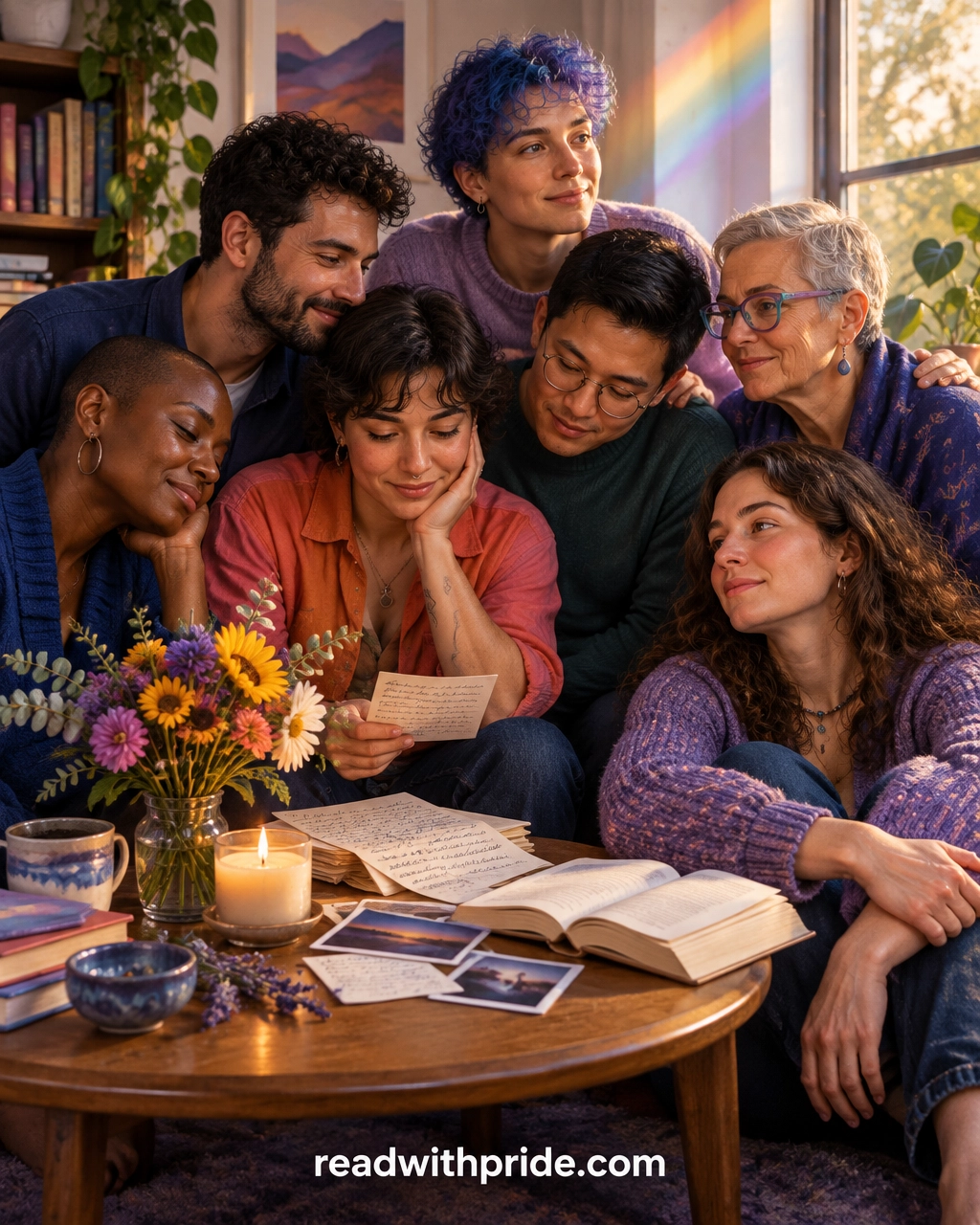
Part of the Queer Healing & Future Visions series by Penny / Read with Pride.
Some days, hope feels natural. Other days, grief sits beside you at breakfast, follows you through work, and claims the most comfortable place on the sofa.
On those days, “look on the bright side” can feel less like encouragement and more like a door quietly closing in your face.
Queer healing asks for something more honest. It makes room for grief without treating it as the end of the story. It recognises LGBTQ+ resilience without demanding that queer people be endlessly strong, cheerful, or inspirational about everything they have survived.
We can acknowledge what hurts and still imagine what comes next.
The grief that does not always receive a public goodbye
LGBTQ+ communities carry many kinds of grief.
There is the grief of losing someone we love, of course. But there is also disenfranchised grief: loss that is real but not always recognised by families, institutions, workplaces, or wider society.
It may be the loss of a chosen-family relationship after an argument or estrangement. It may be the end of a friendship that once helped you survive. It may be transition-related loss: an old name, a former version of your body, a relationship that could not grow with you, or the role others expected you to play.
There is grief in coming out stories shaped by rejection, and grief in the coming out stories that never felt safe enough to begin.
Many queer people also inherit community grief from the AIDS era: stories of lovers and friends whose lives were shortened, memorials that were not respected, families excluded from funerals, and a generation forced to become carers, advocates, historians, and mourners all at once.
Some of this grief is personal. Some of it is collective. Often, it is both.
Naming it does not mean becoming trapped in the past. It means refusing to pretend that these relationships, lives, and losses did not matter.
They mattered. We mattered. Our love mattered.

A few gentle rituals for queer healing
There is no single correct way to grieve, and there is no requirement to make a ritual look spiritual, polished, or Instagram-ready. The most useful practice is one that feels safe enough to try.
1. Create a memory and future altar
Choose a small surface: a shelf, bedside table, windowsill, or even a tray you can put away afterwards.
On one side, place something connected to what you have lost. This might be a photograph, a handwritten name, a flower, a piece of jewellery, or an object that reminds you of a particular person or time.
On the other side, place something representing a future vision. Try a written word such as belonging, rest, home, or joy. Add a seed packet, a book, a drawing, or a small object in a colour that makes you feel hopeful.
This creates a physical reminder that grief and possibility can exist in the same space.
2. Write two short letters
First, write to the person, relationship, community, or version of yourself you are grieving.
You might write:
- What I miss is…
- What I wish people understood is…
- What I am still carrying is…
Then write a second letter to your future queer self or to a future generation of LGBTQ+ people.
Ask:
- What do I hope becomes easier?
- What kind of care do I want to help create?
- What would I like queer people to inherit from us besides survival?
You do not have to send either letter. The point is to let the feelings have somewhere to go.
3. Practise a small act of continuation
Healing does not always arrive as a breakthrough. Sometimes it looks like making tea, watering a plant, cooking something nourishing, or sending a message to someone who understands.
Choose one small act that says: I am still here, and my life is still allowed to contain care.
You might read a chapter of a favourite book, take a walk, listen to music connected to a happier memory, or make a meal that reminds you of someone you miss. Continuing is not forgetting. It is carrying love into another ordinary day.
4. Gather chosen family with consent
If group grief feels right, keep it simple.
Invite a few trusted people to share food, memories, music, or quiet company. Make participation flexible. Someone may want to speak. Someone else may prefer to listen, draw, walk, or leave early.
Before beginning, agree that nobody has to share more than they want to. Ask before offering physical comfort. A hug, hand-hold, or shoulder touch should always be consensual.
A queer book club can also become a gentle place for this kind of connection. You can choose a story about loss, identity, family, or queer love and allow the conversation to unfold naturally. Sometimes a fictional character gives us the first safe language for something we have been carrying ourselves.
LGBTQ+ resilience is not the same as being unaffected
Resilience is often described as bouncing back. But queer lives are not elastic bands, and people are not required to return to an earlier shape after loss.
LGBTQ+ resilience may look like asking for help. It may look like setting a boundary with someone who minimises your grief. It may look like resting, changing your name, finding a new community, or choosing not to attend a family event where your pain will be treated as an inconvenience.
It may also look delightfully ordinary: laughing with friends, making plans, falling in love again, taking up gardening, or becoming the person who knows where the spare keys are kept.
The future is not built only through dramatic acts of resistance. It is also built through everyday care.

Future visions begin with ordinary details
When we talk about optimistic queer futures, it is tempting to imagine something huge: complete safety, perfect healthcare, total acceptance, and a world without discrimination.
Those goals matter. But future visions can also begin much closer to home.
Imagine:
- A home where everyone can display photographs, flags, art, and books without fear.
- A care home where older queer people do not have to return to the closet.
- A school where LGBTQ+ families are treated as ordinary and worthy of respect.
- A neighbourhood where chosen family is understood as family.
- A community garden where queer elders, teenagers, lovers, parents, and friends grow food together.
- A future where trans people are remembered by the names and pronouns that honour their lives.
- A relationship where grief can be spoken about without being hurried away.
- A queer child who grows up expecting joy, not merely preparing for rejection.
These details may sound small, but a future is made from ordinary moments repeated until they become normal.
That is the heart of queer futurity: not pretending everything is perfect, but making more kinds of happiness possible.
Stories can hold grief and hope together
Reading cannot solve every problem. A novel is not a substitute for therapy, medical care, financial support, or a safe place to live.
But stories can offer companionship. They can help us name an emotion, recognise a pattern, or imagine a relationship that makes room for healing.
At Read with Pride, our LGBTQ+ ebooks catalogue includes gay fiction, lesbian romance, MM romance, LGBTQ+ novels, and queer love stories that explore identity, desire, family, loss, courage, and becoming.
For readers drawn to long-term healing and future visions, The Majority Rule: Love in 2150 follows Kai and Dash through a sweeping story of love, social pressure, found family, adoption, memory, and intergenerational hope. Its future is not a simple utopia. It asks difficult questions about power while still believing that people can build something kinder.
The Becoming Jennifer books, not-yet-jennifer-becoming-jennifer-book-one and Becoming Jennifer: Book Two, offer another route into identity, transformation, and the sometimes messy process of becoming more fully yourself.
For readers who want a darker queer fiction recommendation, THE MAKEDA PROTOCOL: A Serial Killer Cult Thriller by Morgan Riley belongs firmly on the thriller shelf. It explores danger, survival, and complicated queer and sapphic lives, so check the content information before reading.
And Imago Nine: The Popstar Apocalypse should be read as a sapphic or bi female-led YA adventure, not as an MM romance. Amaya Reed’s story combines supernatural powers, a high-stakes singing competition, coming-of-age pressure, and a deadly plot. It is a bright reminder that LGBTQ+ fiction 2026 is broad enough to include gay romance novels, lesbian romance, queer YA, fantasy, thrillers, and many other ways of telling queer stories.

A reflection for today
If you are grieving, you do not need to solve everything tonight.
Try asking yourself:
-
What am I grieving?
Name the loss without judging whether it is “big enough.” -
What helps me carry it?
Think of a person, ritual, song, place, professional, community, or story. -
What future detail can I make room for?
Keep it small: a meal, a message, a boundary, a new book, or ten quiet minutes.
If grief feels overwhelming, persistent, or connected to immediate concerns about your safety, please contact someone you trust or an LGBTQ+-affirming therapist, support service, or crisis resource in your area. You deserve care that respects the full complexity of your life.
And if your search history somehow contains the phrase “C Section 2026” alongside queer healing, you are still welcome here. The internet is a strange place; our reading lists are allowed to be equally eclectic.
We are still writing the future
We do not have to choose between remembering and imagining.
We can honour the people and communities we have lost while building safer homes, kinder relationships, stronger chosen families, and more expansive queer futures. We can carry grief without allowing it to become the only story.
Read a story that helps you feel understood. Share a queer love story with a friend. Start a queer book club. Make tea for someone who needs company. Rest when you need to. Dream beyond survival when you can.
Explore the full Read with Pride collection for MM romance books, gay romance novels, lesbian romance, gay fiction, LGBTQ+ novels, queer fiction, and stories of queer healing and hope.
Follow Read with Pride on Instagram and Facebook for LGBTQ+ reading recommendations, new releases, community reflections, and more from our Queer Healing & Future Visions series.
Read with pride. Carry what matters. Make room for what comes next.
#ReadWithPride #Readwithpride #QueerHealing #FutureVisions #LGBTQResilience #MMRomanceBooks #GayRomanceNovels #ComingOutStories #QueerBookClub #LGBTQFiction2026 #CSection2026 #GayFiction #LGBTQNovels #QueerLoveStories #LesbianRomance #QueerFiction #LGBTQReading #ChosenFamily #QueerHope

Leave a Reply
You must be logged in to post a comment.