

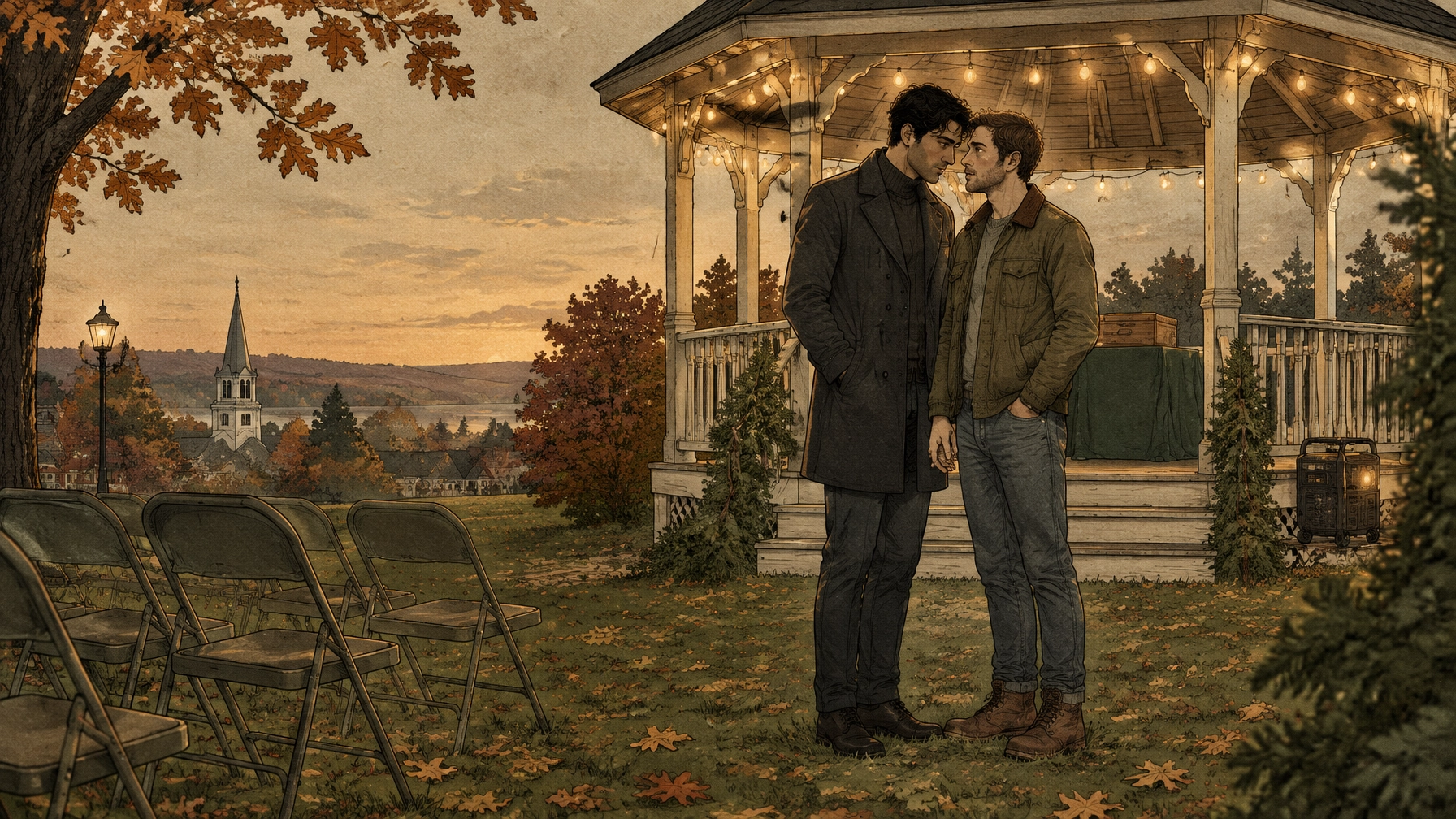
There are places where nobody knows your name.
In the city, Owen had lived for eight years without becoming part of anyone’s permanent record. His name appeared on leases, delivery labels, office directories and the occasional utility bill. It passed through systems without settling anywhere. He could leave a building at midnight and be replaced by another tenant before breakfast. Nobody would ask what he had meant to the room.
He had once found that freedom comforting.
Then he moved to the country for Eli.
Eli’s family had farmed the same stretch of land for four generations. Their names were written in ledgers at the town hall, on brass plaques near the churchyard, in newspaper clippings stored behind the library desk. There were photographs of Eli’s grandfather as a boy, Eli’s father at a harvest supper, Eli himself standing beside a tractor before he was old enough to drive it.
Owen’s name had been on the town records for two years.
That was the difference between being known and being remembered.
A ceremony made for permanence
The town’s time capsule ceremony took place every fifty years, under the white-painted bandstand on the green. Residents were asked to contribute one object that said who they were at that particular moment.
The tradition had begun with a brass tin buried beneath the bandstand by people who were now only names. This year, the town would open the old capsule and bury a new one for the next generation. Some contributions were practical: a local map, a printed newspaper, a seed packet, a child’s drawing. Others were intimate in ways their owners pretended not to notice.
A handwritten recipe.
A worn work glove.
A photograph with the edges soft from being carried in a wallet.
As the autumn evening gathered, folding chairs stood in uneven rows across the grass. Oak leaves skittered beneath people’s shoes. The air smelled of cut grass, cold soil and cedar from the temporary wooden platform. Above them, string lights trembled in the darkening branches while a generator hummed steadily behind the bandstand.
Owen stood beside Eli with his hands in his coat pockets.
He had brought three possible objects.
A city transit card he had kept from the last apartment he shared with nobody.
A silver key to his old flat.
And a photograph of himself and Eli taken beside the farmhouse in early spring, both of them squinting into the sun, Eli’s hand resting on Owen’s shoulder as though it belonged there.
The photograph was the only object that made him afraid.
The fear of becoming a footnote
“You don’t have to put in something important,” Eli said.
The words were gentle. That made them worse.
Owen looked across the green. The town had always been kind to him in the careful, measured way people were kind to someone who had arrived from elsewhere. He was invited to supper. He was asked about the city. People remembered that he took his coffee without sugar.
But kindness was not the same as belonging.
He knew this because jealousy had begun to find him in small, humiliating ways. Not jealousy of another man, exactly, but of the past itself. He envied the people who had known Eli before him. He envied the dead relatives whose names still opened doors. He envied the farm’s long memory, the way every repaired fence and every old photograph seemed to say: someone was here, someone mattered, someone stayed.
Owen feared that he was temporary.
He feared that if he and Eli ever separated, the town would continue without a visible mark of what they had been. Eli would remain Eli: a son, a farmer, a name woven into the land. Owen would become a date on a document and a story no one felt obliged to tell.
That fear was not entirely rational. Love rarely waits for rationality before asking its questions.
“What did you bring?” Eli asked.
Owen felt the photograph inside his coat.
“Something I’m not sure I’m allowed to put in.”
Eli turned toward him. The string lights caught in his eyes.
“There isn’t a rule against it.”
“That isn’t what I mean.”
Being tolerated is not the same as being recorded
For the last two years, Owen had accepted the quiet compromises that came with rural life. The separate introductions. The occasions when people described Eli as “settled” and Owen as “staying with him.” The way some conversations became more cautious when they arrived together.
No one had thrown them out of the town. No one had told them to leave.
But tolerance could still make a person feel as though he were standing just outside the photograph.
In the city, anonymity had protected Owen from that sensation. Nobody recorded him, but nobody could edit him out either. He could be invisible without being rejected.
Here, permanence required participation. It asked him to say: this is my home, this is my person, this is how I want to be found.
The trowel struck the ground with a sharp metallic clink as the ceremony moved toward the burial. The sound travelled through the cold air. Brass against earth. A small, bright declaration.
Eli reached for Owen’s hand.
It was not a dramatic gesture. That was why it mattered. His thumb pressed once against Owen’s knuckles, asking rather than insisting.
Owen thought about the future strangers who would open the new capsule fifty years from now. They might know the farm. They might know the family name. They might know who had served on the council and who had donated the bandstand’s roof.
Would they know that, in the autumn of 2026, two men had stood together on the green and decided they did not want their life reduced to implication?
The object that names them both
When it was Owen’s turn, he carried the photograph to the table.
The paper felt too light for the weight it held.
On the back, he had written:
Owen Mercer and Eli Hart, together at the farm, autumn 2026.
He had almost removed the final word. Together.
It seemed both obvious and astonishing.
The photograph did not explain their entire relationship. It did not promise that love would protect them from fear, resentment or the ordinary damage people could do to each other. It did not turn the future into something safe.
It simply refused to let their present be misnamed.
Owen placed it in the brass tin.
For one suspended second, he expected the town to react. He expected silence to become judgment. He expected Eli to look embarrassed, or proud in a way that would make Owen feel exposed.
Instead, Eli stepped forward and placed his own object beside the photograph: a small brass key from the farmhouse’s back door.
Not a family heirloom. Not something valuable.
A key they both used.
The gesture moved through Owen with startling force. Eli was not asking him to borrow a place in an established story. He was adding a new line to it.
The lid came down.
The trowel scraped earth over the tin. The generator continued its low mechanical hum. Somewhere near the edge of the green, a chair folded with a sudden snap. Oak leaves gathered against the bandstand steps.
The moment was almost ordinary.
That was its power.
A promise you cannot take back
On the walk home, the town lights thinned behind them. Owen and Eli followed the lane between cedar hedges, their shoulders touching beneath the wide dark sky.
“You’re quiet,” Eli said.
“I’m trying to understand what I just did.”
“You put a photograph in a box.”
“I put our names in a box.”
Eli considered that.
“Both names were already there.”
“Not together.”
The distinction stayed between them.
Love can be private and still be real. But there are moments when privacy begins to resemble erasure. There are milestones that do not involve rings, announcements or ceremonies designed for photographs. Sometimes the milestone is the first time a couple chooses to be documented together, not because anyone has demanded proof, but because they are tired of treating their existence as something that must remain strategically unsaid.
For emotionally invested MM readers, that choice carries a particular force. A gay love story’s emotional journey is not only about falling in love. It can also be about deciding whether love is allowed to occupy public space, family history and the future.
That is where character-driven queer fiction often finds its deepest tension. The question is not simply, “Will these two men stay together?” It is also, “Will they risk being known as together?”
Owen had come from a city where he could disappear into crowds. Eli had come from a farm where the past stood visibly in every field. Between them was the difficult, beautiful work of building a shared record.
The time capsule did not guarantee that the town would always understand them. It could not prevent loss, misunderstanding or change. Fifty years from now, the people opening it might read their names quickly before moving on to the next object.
But Owen understood something as they reached the farmhouse gate.
Being remembered was not a reward handed down by a place.
It was a choice you sometimes had to make out loud.
And beside Eli, beneath the cedar-dark sky, he had made it.
For readers drawn to MM romance in unexpected places, emotional MM romance literary fiction and heartfelt queer fiction, this is the kind of milestone that stays with us: not a grand declaration, but a small object placed carefully beside another. A photograph. A key. Two names refusing to become separate stories.
Discover more gay romance books, MM novels, LGBTQ+ fiction and gay love stories through Read with Pride, including Dick Ferguson’s emotionally charged work for readers who value complex characters, lyrical prose and lasting emotional stakes. You can find his books at the Dick Ferguson store on Read with Pride.
#MMRomance #GayRomanceBooks #QueerFiction #LGBTQFiction #GayLoveStories #MMNovels #CharacterDrivenFiction #EmotionalMMRomance #GayRomance #ReadWithPride #Readwithpride #GayLiterature #EmotionallyInvestedReaders
Three possible next Evening Edition stories
-
The First Photograph on the Mantel: An MM couple in a rural town decide whether displaying a shared photograph is more frightening than keeping their relationship private.
-
The Harvest Supper Seat: A city man discovers that being invited to the family table is not the same as being given a place in the family’s future.
-
The Key Beneath the Flowerpot: Two men return to an abandoned city flat and decide which parts of their former lives deserve to be carried into the home they are building together.
Follow us on social media
Follow us on social media for more emotionally immersive MM romance, queer fiction and LGBTQ+ reading recommendations:


Leave a Reply
You must be logged in to post a comment.