

Category: Unexpected Places | Morning Edition
The invitation on the counter
The invitation had been on the kitchen counter for three days. Theo had left it there without comment, beside the bowl of keys and a receipt neither of them needed. Ruben found it when he came home from the harbour, cold still in his hands, his canvas bag dragging at his shoulder.
He read the date. He knew the date. Thanksgiving at Theo’s father’s house, with Theo’s sister there too. The second one since Theo’s mother died. For years Ruben had found a reason not to go: the contract, the promotion, the review. Each excuse had been true enough to stand up by itself. None had been the whole truth.
Theo had stopped asking if Ruben would come. The silence felt worse than the question.
They had been together nine years. Theo designed theatre lighting in the Mission, where timing was everything: the exact second a light came up, the held breath before a scene changed. He was warm and quick and funny, good at filling silences. Lately, Ruben thought, he seemed tired of doing it.
Ruben listened to water for a living. As a marine acoustics technician, he could hear trouble in a recording: a cracked hull, a whale in the channel, a boat coming through fog. He trusted what sound could prove. Feelings were less cooperative.
“I’m waiting for things to settle,” he said when Theo asked, finally, in the kitchen.
Theo looked at him. “You always are.”
The next morning, Ruben suggested they go to the Wave Organ.
The bay does not wait
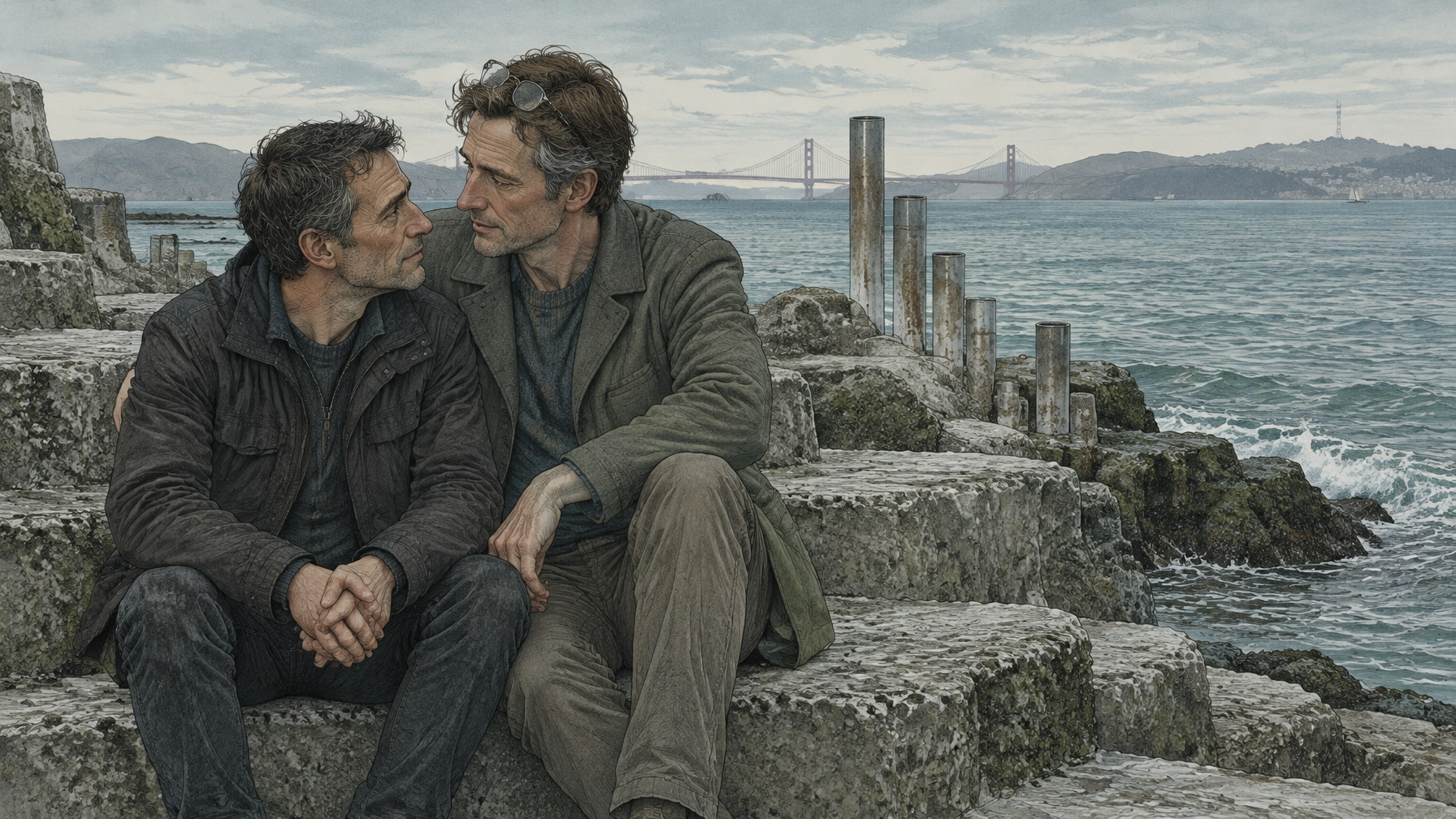
It was an ordinary Tuesday, and the tide was high. At the end of a man-made jetty in the Marina District, the Wave Organ faced the bay. Across Marina Boulevard, the Palace of Fine Arts stood beyond the water and traffic. The sculpture’s uneven stone terraces invited visitors to climb from one level to another; the place felt less like a stage than a thought left open.
Ruben had brought his hydrophone gear in a canvas bag. He talked as they walked, explaining the pipes, the water, the way sound formed. Theo listened with his arms crossed.
The Wave Organ was completed in 1986. Artist Peter Richards made it in collaboration with master stonemason George Gonzalez, with the Exploratorium as sponsor. Its 25 pipes (PVC and concrete, set at different lengths and depths) rose from the stone like periscopes. Moving water pushed and drew at the air inside them. Each pipe became a vibrating column, amplifying the bay in a way that recalled a pan flute.
At high tide, water climbed into the pipes, shortening the air columns and lifting the pitches. At low tide, the notes sank. The sound was not a tune. It was gurgles, hisses, sucking breaths and low booms, arranged by water with no interest in repeating itself.
Ruben explained all of this.
Theo stared out over the bay. “You brought me here to teach me how it works?”
Ruben could have said no. He could have said he wanted to show Theo something beautiful. But he had already put his fear between them, dressed as information.
The stones underfoot were beautiful and unmistakably old: carved granite and marble salvaged from early-1900s cemetery relocations, remnants of buildings lost in the 1906 earthquake, and old San Francisco curb stones, some still marked with traces of red paint. The past had not disappeared. It had been given another shape, another use.
Ruben looked at it and understood nothing useful.
The sound that would not come back
Theo climbed to a higher terrace and sat down. Ruben followed, leaving the gear bag between them like a third person.
He told Theo about Richards moving to San Francisco in 1970, fascinated by tides. The first he had lived beside. About the rough prototype built on that same jetty for the New Music ’81 festival, mic’d and connected by telephone wire to the Exploratorium, then housed at the Palace of Fine Arts. The bay had played inside the museum. Director Frank Oppenheimer had told Richards they had to do something with it.
When the work began in earnest, Richards and Gonzalez discarded the drawings and models. They let the stonework determine what was needed.
Ruben stopped. He had been reciting facts as though one of them might give him a safe way into the conversation.
A wave moved through the pipes. The sound rose, shook, and vanished. He thought of the notes as he would a recording: something to capture, replay, examine. But no recording could return this one. The instrument never made the same sound twice. Each wave made a note that existed once and was gone.
“I keep thinking I can go back and fix things,” he said.
Theo turned toward him.
“I’ve treated my life like a session I can repair in the mix. If I wait long enough, maybe I’ll know what to say. Maybe I’ll get it right.” Ruben’s voice stayed flat. He could hear it. “I don’t want to be wrong out loud.”
Theo’s face tightened. He had his own truth, and it came without decoration.
“You’re not waiting for a good time. You’re waiting for me to stop asking, so you never have to be the one who said no.”
Ruben felt the words land. He wanted to argue with them. Instead, he said, “If I say it in front of your family and it goes wrong, I’m wrong in front of everyone, forever. You’ve never had to be wrong in front of a room.”
It was true. It was also an answer shaped like a shield.
Neither of them looked away. The bay continued its unrepeatable work.
A promise with the flaw showing
The highest water was already behind them on the jetty. Ruben watched a little water withdraw from the pipes and felt, absurdly, that he had missed his chance to speak at the right moment. Then he spoke anyway.
“Come to Thanksgiving. I’ll probably cancel in October. I’m telling you now so you know I’m not lying about the rest of it.”
It was not a beautiful sentence. It did not turn the years of refusals into something less costly. It offered Theo no guarantee that this year would be different. Ruben heard the weakness in it and did not try to hide it.
Theo did not forgive him on the spot. He reached for the headphones Ruben offered and settled them over his ears. For a long while, he listened to the bay. Ruben watched his partner’s expression change as the pipes caught the water: concentration, surprise, a crease of amusement.
“It sounds like a stomach,” Theo said.
Ruben laughed. It came out badly. Theo laughed too, and his eyes were wet. For a moment, they were not fixing anything. They were simply there, sharing a sound neither of them could keep.
“October, then,” Theo said. “I’ll hold you to it.”
It was not a yes. Ruben knew better than to turn it into one.
For readers drawn to a gay love story emotional journey that honours both tenderness and consequence, this is the kind of moment that stays unresolved in the honest way: not empty, not healed, but spoken. It is why character-driven queer fiction holds emotionally invested MM readers longer than any grand gesture can, and why MM romance unexpected places like this one earn their keep: the place does the arguing, and the men have to answer it. If emotional MM romance literary in voice is what you look for, you will find it in Dick Ferguson’s work through the Read with Pride e-book collection.
The way back
They walked back along the jetty as the tide dropped. Behind them, the pipes fell to lower notes. The old stones held the traces of lives and buildings that had changed shape without being made new. Ruben’s hand rested at the back of Theo’s neck, a small touch that asked for nothing and promised nothing it could not keep.
In the haze, the Golden Gate Bridge went silver. The morning opened around them: the water, the distant hills, the ordinary work of people moving through a city. Somewhere behind them, the Wave Organ made another sound no one could summon twice.
The invitation was still unfinished. October was still ahead. Theo had not agreed to Thanksgiving, and Ruben had not become a man who knew how to enter a room without fearing what it might cost.
But for the first time, the invitation had been spoken between them. The fear had a name. The answer might yet change.
They kept walking.
The Wave Organ, its history, construction and location are real; Ruben Vilar and Theo Hale, their relationship and the events in this story are fictional.
Follow us on social media
Follow Dick Ferguson and Read with Pride for more stories and reflections: Instagram · X · Facebook · Read with Pride
#MMRomance #QueerFiction #GayRomance #ReadWithPride #LGBTQBooks #BookLovers #LiteraryFiction #MorningEdition #SanFrancisco #WaveOrgan #UnexpectedPlaces
Next Morning Edition, Rare Experiences: Postman's Park in the City of London, where a wall of hand-painted ceramic plaques remembers ordinary people who died saving strangers, and two men read the names of love that arrived too late to be spoken.
Next Morning Edition, Unexpected Places: The One Square Inch of Silence in the Hoh Rain Forest, the quietest place in America, where two men discover that some confessions only survive in a room quiet enough not to flinch.
Next Morning Edition, Unexpected Places: The Singing Ringing Tree above Burnley, a wind-played sculpture of steel pipes on the Lancashire moors, where two men learn that a song can be made without anyone deciding to sing.
Images


Leave a Reply
You must be logged in to post a comment.