

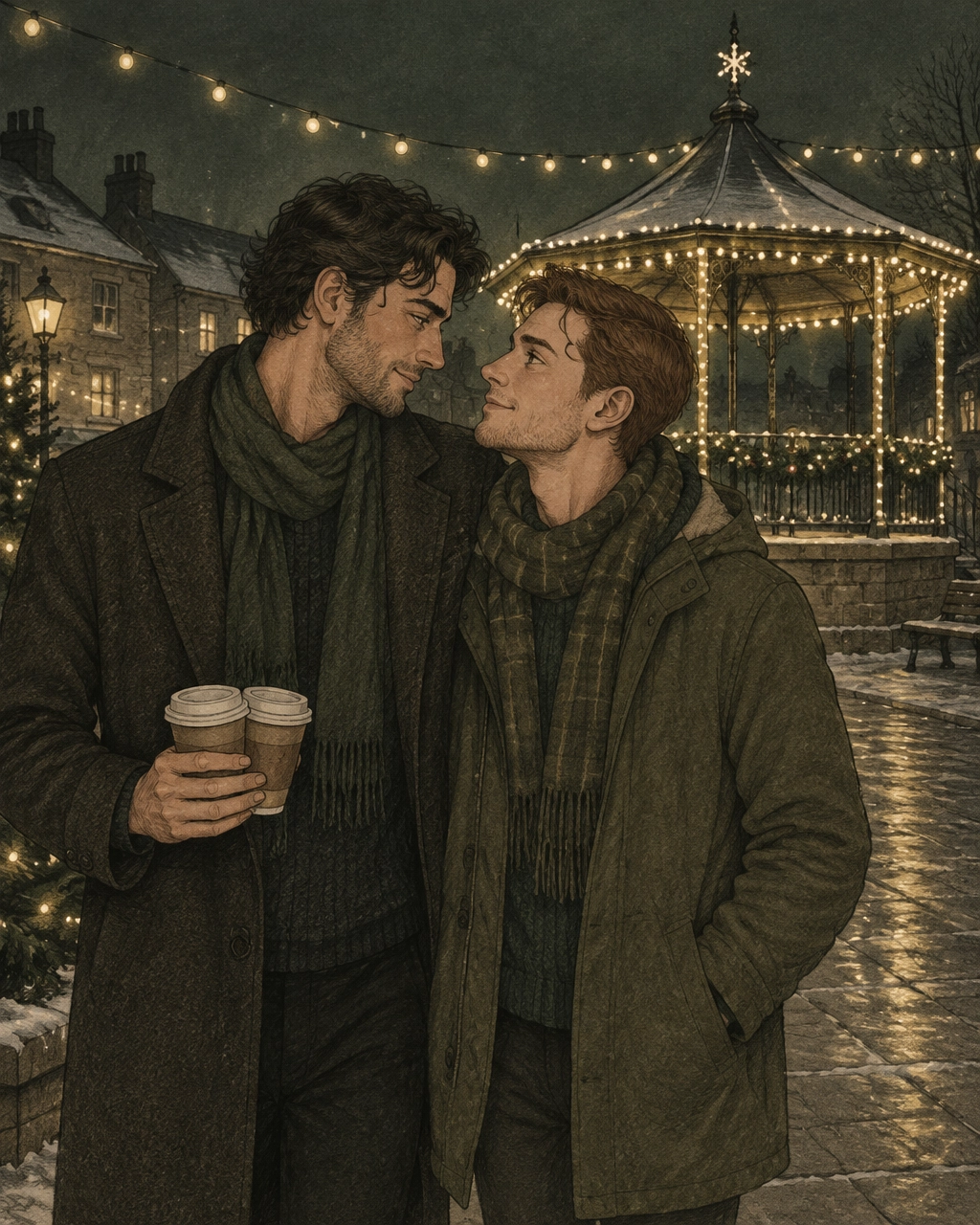
The shop still smelled faintly of the last man’s cigarettes and his coffee. In December, the cold held both smells close to the walls, along with the dust of old signboards and the sweet, sharp trace of gilding size.
The Shop That Smelled of Somebody Else
I was thirty-nine and six months into the lease in Ashwell. The old signwriter’s widow had handed me the keys and a ring of labels written in his careful block capitals. I had moved towns five times in fifteen years. Each time, I left before anyone had to ask whether I meant to stay.
The shop window was crowded with Christmas lettering I had painted for the bakery, the butcher and the bookmaker. Gold stars, white flourishes, red berries. In January, someone would wash them off. I charged for the work, naturally. Still, when I wrote the figures on an invoice, a small part of me felt I ought to apologise.
I was very good at making other people’s names beautiful. Fascias, window glass, memorial plaques. I had painted the lettering on the side of a bandstand once, in a town whose name I no longer used unless I had to. My old teacher used to say, “You never sign a repair.” I’d taken it as instruction. I’d never once put my own name on a piece of work.
A Man with a Clipboard
Ellis came in with a clipboard tucked beneath his arm and cold in the seams of his coat. He owned the electrical shop on the corner of the square and had done Ashwell’s Christmas lights for eleven years. The pencil checklist was smudged at the edges. His right shoulder sat a little higher than the left, held that way by years of ladders. There were small solder burns on his hands.
He crossed things out instead of rubbing them away. One firm line through each completed job, leaving the words legible underneath.
“The bandstand sign is yours now,” he said. “Committee wants a new one for the switch-on.”
I looked at the pencilled list. Test generator. Check sockets. Secure cable. I’d seen Ellis’s writing often enough to know how hard he pressed on the downstrokes.
“They want the old wording?” I asked.
“Same wording. Better board.” He added a mark beside it. “They asked if you’d sign it.”
His pencil stopped moving. I thought of the small square at the bottom right, the place where a maker might leave a name. I said I’d have it ready.
Gold Leaf at Three in the Afternoon
At three, the December light was already thinning. I set the board flat and laid out the gilder’s cushion, knife and leaf. White spirit and rabbit-skin glue lingered in the room. The gold leaf trembled when I lifted it. It was so thin that my breath could alter its course, and the draught under the back door seemed to know this.
I worked slowly. Gilding size first, left to reach the right tack. Then the leaf, coaxed into place with the brush. A corner caught and tore. I patched it with another piece so small it clung to a dry finger. The line of gold went down cleanly after that, letter by letter, bright against the dark ground.
At the bottom right, I left a square of untouched paint. I sharpened a pencil and wrote my name there, lightly enough to disappear beneath a thumb. The letters looked unfamiliar, though I had drawn them thousands of times for other people. I rubbed them out, then tried again.
When I picked up the brush, my hand stayed still for a long time. Then I painted the first stroke in gold.
Nine, Eight, Seven
By the time the square filled, the brass band was slightly flat and the PA gave the mayor’s voice a thin metallic edge. An urn held something hot. Mince pies sat in a tin, their pastry already crumbling onto people’s thumbs. Children watched from shoulders. A cable had been taped flat across the paving, and the smell of the diesel generator settled over the crowd.
Ellis moved through it with his clipboard, checking the list. He refused the mayor’s public thanks with a turn of his head and a brief look at the generator. The mayor kept speaking. Ellis crossed another item off.
“Nine, eight, seven,” the crowd called. The generator surged. The lights came on half a second late, and the sound of the square arrived after them: cheers, a few claps, a child shouting into the pause.
The bandstand sign lit up. Nobody looked at it. That was the point. Its letters were clear from the pavement, doing what letters were meant to do. Ellis stood on the platform, his shoulder strapped, his gaze on the switch box. Across the crowd, he looked at me once. A second and a half, perhaps. Then he went back to the list.
The Side of the Bandstand
Afterwards, the square emptied in uneven pieces. The urn was unplugged, ticking as it cooled. Someone carried a tuba across the road, its brass gone cold and dull under the lamps. There was orange peel by the kerb and a dropped glove near the bandstand steps.
I stood beneath the sign. The lights were off now. I could see the gold in the dark, not shining so much as holding the little that remained of the day. No one was looking at me. I had spent years preferring it that way.
A lorry reversed somewhere behind the Co-op, its warning beeps reaching the square one by one. I thought of the rooms I had left, the boxes I had not unpacked, the names on work I’d finished and handed over. The cold pressed through my coat. I kept my hands in my pockets until the pavement was almost empty.
Ink Instead of Pencil
At home, Ellis made tea while I sat at the table. He had brought the clipboard in, and it lay beside the mugs with the evening’s marks and crossings. Wool and wet coat warmed slowly near the radiator. I could still smell the generator on my sleeves.
He turned to a clean line on the rota. “Put your name on next year’s.”
Then he handed me a pencil. “In pencil. In case.”
I took the pencil, rolled it once between my fingers and set it down. In the drawer was a pen from the electrical shop, black plastic with Ellis’s shop name printed along the barrel. I used it instead.
Ellis looked at the line. “Right.”
He took a sip of tea. A moment later, he said, “I saw your signature on the bandstand.”
The pen was his, and the little square of gold had kept its place.
For readers who enjoy character-driven queer fiction, quiet MM romance in unexpected places and a gay love story emotional journey that stays with you long after the last page, Dick Ferguson’s novels are available through his Read with Pride store. Explore more LGBTQ+ books at Read with Pride, a home for emotionally invested MM readers who like their emotional MM romance literary and unhurried.
Follow us on social media: Instagram · X · Facebook · Read with Pride
#MMRomance #GayLoveStory #QueerFiction #EmotionalMMRomance #ReadWithPride #CharacterDrivenFiction #SlowBurn #GayBooks #LGBTQBooks


Leave a Reply
You must be logged in to post a comment.