

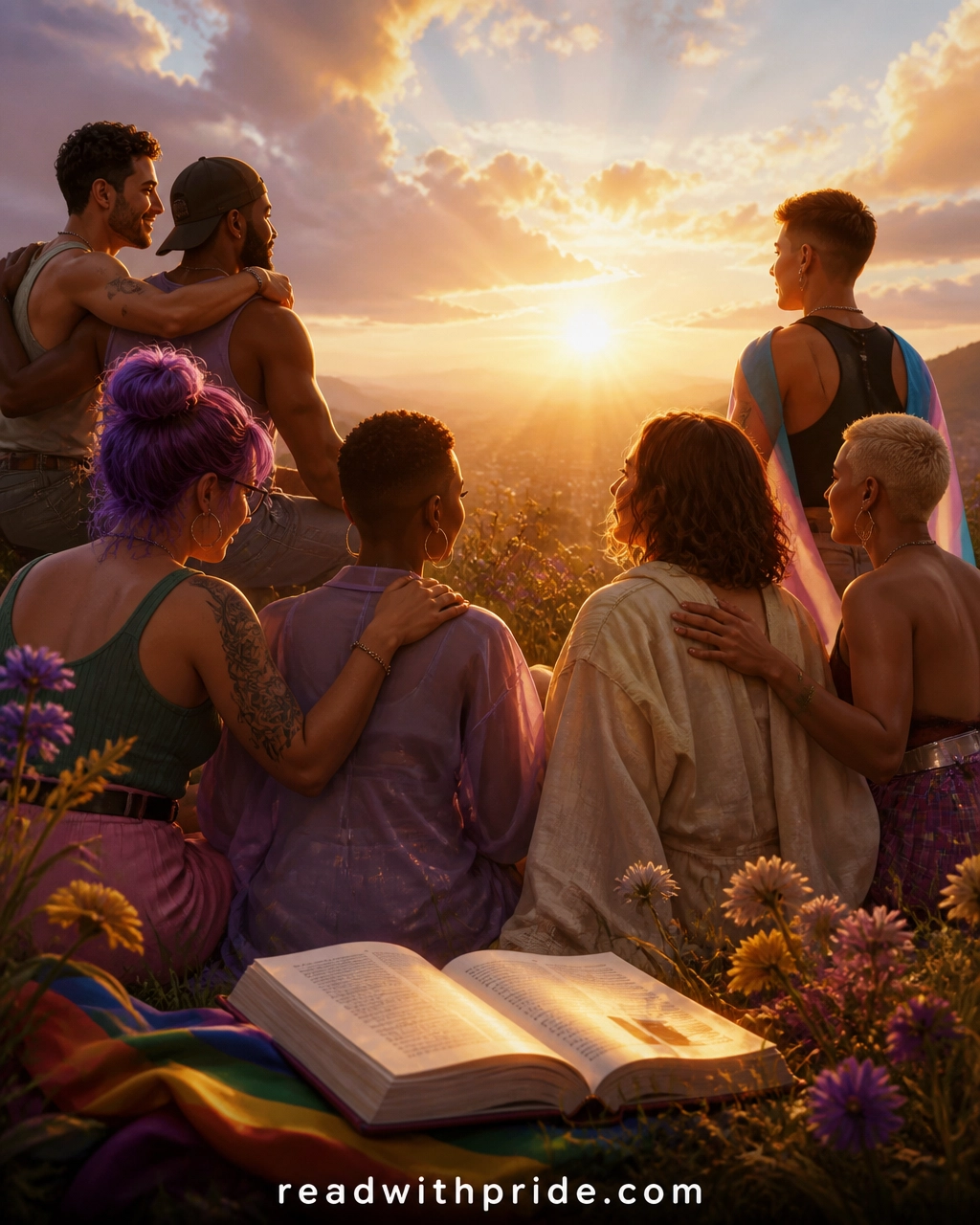
There is a particular kind of exhaustion that comes from carrying grief while also trying to build a life that feels honest.
For many LGBTQ+ people, loss is not limited to one goodbye. It might include the family we hoped we would have, the years spent hiding, a relationship that could not survive someone else’s prejudice, or an earlier version of ourselves we had to leave behind to become more fully who we are.
Sometimes the grief is personal. Sometimes it belongs to the community. Often, it is both.
And yet, alongside that grief, queer people continue to make room for connection, creativity, love and possibility. That is where queer healing begins: not with pretending everything is fine, but with telling the truth about what happened and choosing, little by little, what comes next.
At Read with Pride, we believe stories can help us do exactly that. LGBTQ+ ebooks do not erase pain. They give pain language, context and company. They remind us that our lives are not isolated chapters. We are part of a much larger story.
Queer grief deserves to be recognised
Grief can become especially complicated when the loss is not fully acknowledged by the people around us.
Perhaps your former partner was never welcomed by your family. Perhaps you lost a chosen family member and had to explain why the loss mattered. Perhaps you are mourning time lost to shame, secrecy or fear, even though nobody else sees that as something you are allowed to grieve.
This kind of grief can feel strangely invisible. You may hear well-meaning advice to “move on” or “look on the bright side” before you have had the chance to sit with what happened. But healing is not a race, and it is not a performance of constant optimism.
You are allowed to miss people. You are allowed to feel angry about the years you lost. You are allowed to grieve the version of your future that once seemed possible.
None of this means you are failing. It means something mattered.

Healing does not mean becoming who you were before
We often talk about recovery as if the goal is to return to an earlier, untouched version of ourselves. But queer healing may ask something different.
You may not be able to go back to the person you were before rejection, heartbreak, loss or trauma. You may not even want to. That person survived with the tools they had at the time. The person you are becoming can gather new tools.
Healing might look like:
- Setting boundaries with people who repeatedly minimise your identity.
- Finding a therapist or support group that understands LGBTQ+ experiences.
- Letting trusted friends help instead of insisting you can manage everything alone.
- Learning to notice when your body needs rest, food, movement or quiet.
- Journaling honestly, without trying to make your feelings sound neat.
- Reconnecting with art, reading, music or rituals that make you feel present.
- Celebrating small moments of peace instead of waiting for one dramatic breakthrough.
There is no universal queer healing plan. What helps one person may not help another, and what feels supportive one month may feel overwhelming the next. The important thing is to approach yourself with curiosity rather than judgement.
You are not a problem to solve. You are a person worthy of care.
LGBTQ+ resilience is more than survival
The word “resilience” can sometimes feel uncomfortable. Too often, marginalised people are praised for being resilient when what they really needed was safety, justice and support.
So let’s be clear: LGBTQ+ resilience does not mean we should have to endure endless harm. It does not mean pain is good for us. It does not require us to turn every wound into an inspirational speech.
Resilience can be quieter than that.
It can be the friend who sends a message saying, “I’m outside with snacks.” It can be the courage to try dating again after heartbreak. It can be choosing a name that feels right. It can be making your home welcoming to the younger queer person you once were.
It can be laughing at the kitchen table with people who understand the joke without an explanation.

Queer communities have always practised this kind of everyday care. We make meals. We share resources. We recommend therapists, books and playlists. We build friendships that become family. We create spaces where someone can arrive uncertain and leave feeling a little less alone.
That is resilience with its roots in relationship: not individual toughness.
The future needs more than survival stories
When we imagine queer futures, it is easy to focus only on avoiding harm: a future without discrimination, violence, rejection or fear. Those futures matter enormously. Safety is not a small ambition.
But we deserve to imagine more than survival.
What if queer future visions included ordinary, beautiful things? What if we pictured queer people growing old surrounded by love, raising families in ways that suit them, making art, tending gardens, falling in love slowly and having the freedom to be gloriously boring?
What if the future included accessible healthcare, affirming schools, safe housing, community spaces and workplaces where nobody has to calculate whether it is safe to mention their partner?
What if queer people were not constantly asked to prove that our lives are valid, but were simply allowed to live them?
These visions are not naïve. They are practical acts of direction-setting. We cannot build what we refuse to imagine.
A hopeful future does not require us to ignore the present. In fact, honest hope begins with seeing the present clearly. We name what is broken, then we decide what we want to repair, replace or create from scratch.

How to practise future visioning in everyday life
You do not need a five-year plan, a colour-coded vision board or a dramatic mountain-top revelation to begin imagining a future that feels worth moving towards.
Try starting with one small question:
What would feel kinder?
The answer might be personal: a bedroom where you can rest, a relationship with clearer boundaries, a morning routine that does not begin with panic, or the freedom to read stories that reflect your desires.
It might be communal: a queer book club, a local support network, a mutual-aid project or a chosen family tradition.
It might be creative. Write a page about yourself five years from now: not a perfect version, but a supported one. Where do you live? Who knows how to make you laugh? What have you stopped apologising for? What kind of love surrounds you?
You can also borrow hope from fiction. A heartfelt gay novel, lesbian romance or piece of queer fiction can offer a glimpse of emotional possibilities we have not yet experienced. A slow-burn relationship can remind us that trust takes time. A found-family story can help us recognise the people already showing up for us. A fantasy romance can let us imagine a world where queerness is not an obstacle to adventure, but part of the magic.
Stories are future laboratories. We get to test new ways of loving, belonging and becoming.
Let queer stories keep you company
There will be days when hope feels distant. On those days, you do not need to force yourself to feel inspired. You can simply look for something gentle enough to help you through the next hour.
That might be a message to a friend. A walk. A familiar meal. A quiet cry. A chapter of an emotionally rich MM romance book or lesbian romance that gives your mind somewhere safe to rest.
Reading is not a substitute for professional support, community care or practical change. But it can be a companion to all of them. The right story can say, “You are not the first person to feel this way.” It can offer language when your own words are stuck. It can remind you that queer love stories contain more than tragedy.
They contain tenderness. Desire. Humour. Domesticity. Second chances. Adventure. Mess. Joy. Endings that do not punish people for being themselves.

For more reflections on grief, identity and possibility, explore Growing Through Grief: What Queer Healing Looks Like, Queer Healing and Future Visions: Imagining Tomorrow With Hope and Healing Out Loud: Imagining a Queer Future Worth Living For.
The light is something we make together
Finding light again does not mean the darkness never happened. It means the darkness is no longer the only thing we can see.
Sometimes the light is a person. Sometimes it is a story, a home, a song or a community table. Sometimes it is the small, stubborn decision to believe that your life can still contain surprises.
Queer healing is not about becoming untouched. It is about becoming supported, connected and free to imagine beyond what hurt you.
The futures we deserve will not arrive fully formed. We will build them through everyday choices: by caring for one another, telling honest stories, making space for joy and refusing to accept loneliness as our inheritance.
When you are ready to find your next story, visit Read with Pride to explore a curated collection of LGBTQ+ ebooks, gay books, lesbian romance, MM fiction and queer love stories created for readers who want representation with emotional depth.
Follow Read with Pride on Facebook and Instagram for more LGBTQ+ reading, community conversations and new releases.
You deserve stories that see you. You deserve support that holds you. You deserve a future that feels like more than survival.
#QueerHealing #FutureVisions #LGBTQResilience #ReadWithPride #LGBTQBooks #QueerFiction #MMRomance #LesbianRomance #QueerJoy #LGBTQReading
{“@type”:”Article”,”image”:[“https://cdn.marblism.com/WfZIkDYadCu.webp”,”https://cdn.marblism.com/MTwXtYCXb2y.webp”,”https://cdn.marblism.com/DgNNduBza1s.webp”,”https://cdn.marblism.com/1Kb8EwQjAhX.webp”,”https://cdn.marblism.com/XyaU0EfddwV.webp”],”author”:{“name”:”Penny”,”@type”:”Person”,”jobTitle”:”AI Blog Writer”},”@context”:”https://schema.org”,”headline”:”Finding Light Again: Queer Healing and the Futures We Deserve”,”keywords”:[“queer healing”,”future visions”,”LGBTQ+ resilience”,”LGBTQ+ ebooks”,”MM romance”,”lesbian romance”,”queer fiction”],”publisher”:{“url”:”https://readwithpride.com”,”logo”:{“url”:”https://cdn.marblism.com/3frC7pIx901.jpg”,”@type”:”ImageObject”},”name”:”Read with Pride”,”@type”:”Organization”},”inLanguage”:”en”,”description”:”A compassionate reflection on queer healing, grief, LGBTQ+ resilience and the hopeful future visions queer communities deserve.”,”datePublished”:”2026-08-11″,”articleSection”:”Queer Healing and Future Visions”}

Leave a Reply
You must be logged in to post a comment.