

readwithpride.com
There is a kind of grief that does not always arrive with a clear beginning or an obvious ending. Sometimes it follows the loss of a partner, friend, family member, mentor, or chosen-family member. Sometimes it is grief for the years spent hiding, the relationship that was never publicly recognised, or the younger version of yourself who deserved more safety and tenderness.
Sometimes it appears while scrolling through the news, hearing another story of discrimination, or remembering someone who did not get to experience the queer future they helped make possible.
And sometimes it shows up on an entirely ordinary Tuesday, because emotions apparently enjoy dramatic entrances.
This is where queer healing begins: not by pretending the pain never happened, but by making room for the whole truth. We can tend to our wounds while imagining something kinder ahead. We can honour what has been lost without allowing loss to become the only story available to us.
That is the work of future visions. Not glossy perfection. Not a fantasy where nobody struggles and every group chat is emotionally mature. We mean real, hopeful futures filled with safety, chosen family, accessible care, creative freedom, tenderness, laughter, and the right to be gloriously, inconveniently ourselves.
Queer grief is layered, complicated, and real
LGBTQ+ grief can be difficult to name because not every loss fits the traditional script.
You may be grieving:
- A chosen-family member whose presence made life feel safer.
- A relationship dismissed by relatives or institutions.
- The years spent masking, hiding, or trying to become acceptable.
- A friendship that ended after you came out, transitioned, or set a boundary.
- A queer community space lost to distance, funding cuts, violence, or time.
- A childhood that never felt free.
- A future with someone you loved, even if the relationship ended long ago.
- The version of yourself you might have become in a kinder world.
These losses are real, even when other people do not know how to recognise them. When someone says, “You were not married,” or “You barely knew them,” they may think they are offering perspective. Often, they are adding another layer of loneliness.
Queer healing starts with telling the truth:
This mattered to me, and I am allowed to mourn it.
You do not have to defend the size of your grief. You do not need official paperwork to prove that someone was family. You do not need to make your pain more convenient for people who have never had to question whether your love would be acknowledged.
Healing is not the same as moving on
“Moving on” can sound harmless, but it often suggests that healing means leaving the past behind and returning to a version of normal.
For many queer people, normal was never especially welcoming in the first place.
Healing may be less like closing a book and more like learning how to read a difficult chapter without letting it define the entire story. Some days, you may feel calm and grounded. Other days, a song, smell, date, photograph, or completely random supermarket aisle may open the emotional floodgates.
That is not failure. It is the very human experience of carrying love, memory, and change.
You are allowed to heal slowly. You are allowed to feel angry. You are allowed to laugh at an absurd meme ten minutes after crying. You are allowed to enjoy Pride, a date, a good meal, or a comforting piece of queer fiction without feeling guilty.
Joy does not betray the people or possibilities you have lost. Sometimes joy is one way of carrying them forward.

Chosen family turns care into something practical
Chosen family is not a bonus feature for many LGBTQ+ people. It is often the structure that helps us survive and thrive.
It may include friends, partners, former partners, neighbours, colleagues, mentors, queer elders, online community members, or the person who brings food before you have even worked out what you need. It can be beautifully unconventional and still deeply committed.
During grief, chosen family can offer:
- Witnessing: someone who remembers what happened and understands why it mattered.
- Affirmation: people who treat your identity and relationships as real, not debatable.
- Practical support: meals, lifts, childcare, company at appointments, or a place to rest.
- Emotional safety: room to cry, vent, be quiet, or change the subject completely.
- Continuity: reminders that your life is still connected to a wider community.
If you are supporting a grieving LGBTQ+ person, do not assume biological relatives are their closest support network. Ask who should be included. Use the words they use for their relationships. Do not erase a partner, ex-partner, friend, or chosen-family member because their connection does not resemble your own.
Sometimes the most healing sentence is wonderfully simple:
“I know this relationship was real, and I am here to remember it with you.”
Read with Pride explores queer families and relationships through thoughtful stories and articles, including LGBTQ+ relationships and life milestones and the homes we make through domestic queerness and belonging.
Small rituals can give grief somewhere to go
When traditional rituals do not reflect your identity, culture, beliefs, or relationships, you are allowed to create your own.
A ritual does not need to be grand. It might be:
- Lighting a candle on an anniversary.
- Cooking someone’s favourite meal.
- Making a playlist and listening with trusted friends.
- Visiting a place that mattered to you.
- Writing a letter you do not send.
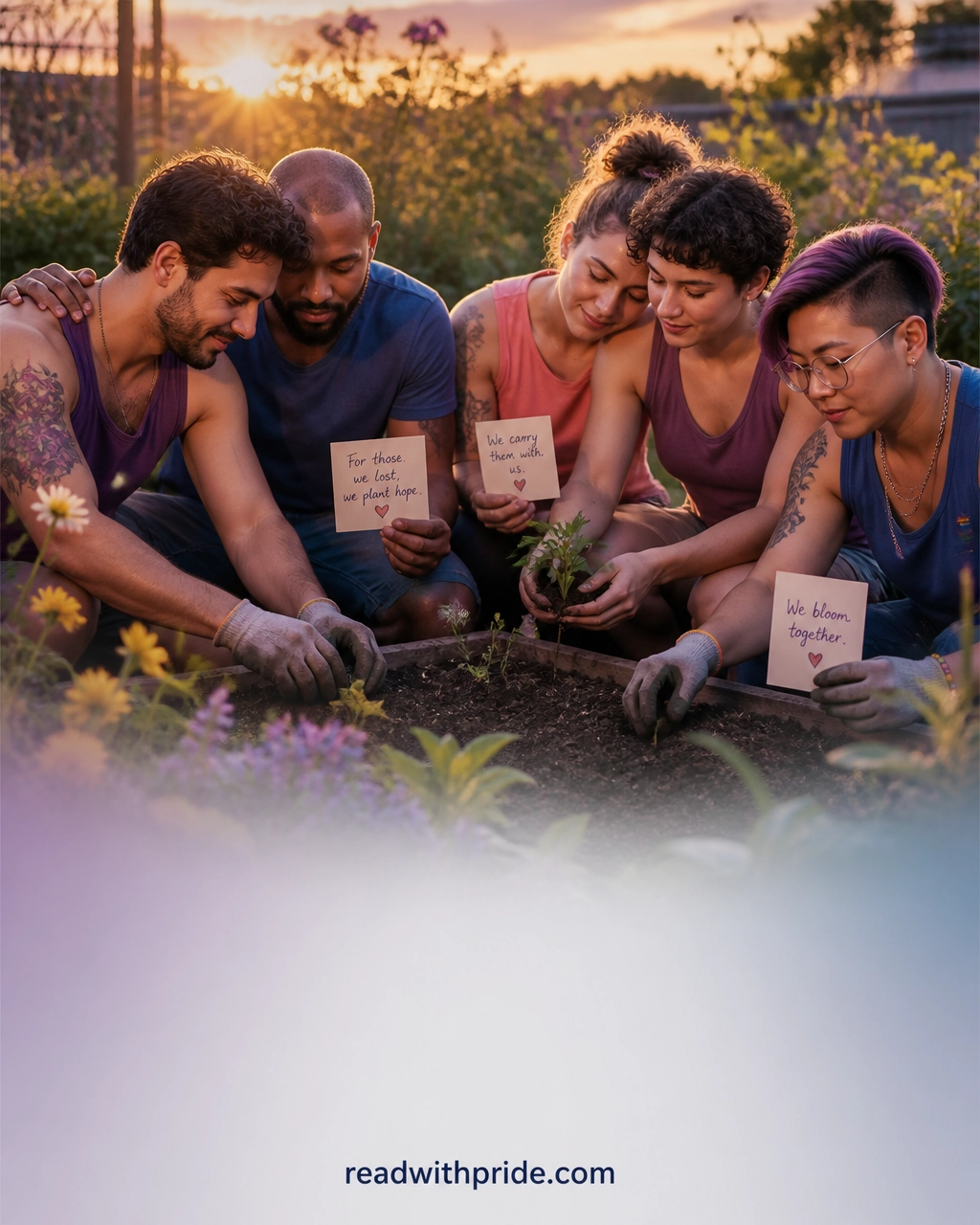
- Planting flowers, herbs, or a tree.
- Sharing memories in a group chat where nobody tells you to “be strong.”
- Reading an emotional gay love story that gives your feelings somewhere to land.
Ritual is not about forcing closure. It is about creating a container for memory. It says: this person, relationship, or chapter belongs in my story.
Stories can become part of that ritual too. LGBTQ+ ebooks, gay novels, lesbian romance, and emotionally honest queer fiction cannot erase grief, but they can offer language, recognition, and companionship. Browse the Read with Pride LGBTQ+ blog and article collection for more conversations about identity, relationships, community, and healing.
LGBTQ+ resilience is more than being strong
The word “resilience” gets used frequently when people talk about LGBTQ+ communities. It can be empowering, but it can also become another demand: keep going, stay positive, turn your pain into a lesson, and preferably do it with excellent lighting.
But LGBTQ+ resilience does not mean being indestructible. It does not mean coping alone or recovering on someone else’s timetable.
Resilience can be soft. It may look like:
- Asking for support before reaching crisis point.
- Resting without treating rest as a reward.
- Setting a boundary without writing a three-page apology.
- Letting trusted people witness your sadness.
- Finding an LGBTQ+-affirming therapist or support group.
- Turning off notifications when the world feels too loud.
- Choosing a safer space instead of proving you can endure an unsafe one.
- Accepting that today is not the day for a brave face.
Resilience is also collective. It lives in shared meals, mutual aid, community organising, queer book clubs, intergenerational storytelling, and the friend who sends exactly the right voice note.
It lives in our stories, too. The best MM romance books, lesbian romance novels, gay fiction, and LGBTQ+ fiction can remind us that vulnerability is not weakness and that queer characters deserve futures beyond tragedy. A slow-burn romance, a second-chance love story, or a tender chosen-family narrative can offer emotional rest when real life has been demanding far too much.
Future visions begin with a small question
When life has required constant vigilance, imagining the future can feel risky. What if we hope for something and lose it? What if the world changes again? What if we are not equipped for the life we want?
You do not need a ten-year plan or a colour-coded vision board. Start with one question:
What would make tomorrow feel a little more like home?
The answer might be enormous: safe housing, affirming healthcare, legal protection, family acceptance, or freedom from violence.
It might also be wonderfully ordinary:
- Waking up without bracing yourself before checking your phone.
- Sharing a home with people who understand your boundaries.
- Having a partner who knows how to support you when you are overwhelmed.
- Seeing queer elders treated with dignity and care.
- Building a friendship circle that feels steady rather than conditional.
- Reading openly in a public place without worrying who is watching.
- Growing up knowing your identity is not a problem to solve.
These small visions are not insignificant. They give our values somewhere to land.
Try writing a “future postcard” to yourself. Describe one ordinary day in a life where you feel safe enough to relax. Who is nearby? What can you hear? What are you doing with your time? What no longer occupies your thoughts?
It does not need to be poetic. “I have a kitchen where everyone is welcome and nobody comments on my mugs” is a perfectly valid utopia.

Healing is personal, political, and intergenerational
Queer healing is not only an individual project. We cannot meditate our way out of discrimination, inaccessible healthcare, unsafe housing, poverty, or minority stress.
Personal care matters. So does collective action.
Supporting queer organisations, sharing resources, checking on isolated people, learning about intersectionality, and making our communities safer are all forms of future-building. This work must include those who are too often pushed to the edges of LGBTQ+ conversations: trans people, disabled queer people, QTBIPOC communities, migrants, older LGBTQ+ people, and anyone living outside a tidy public narrative.
A hopeful queer future cannot be built by asking the most vulnerable people to wait patiently for their turn. It has to make room from the beginning.
That is one reason representation in literature matters. Gay romance books, M/M books, lesbian romance, queer fantasy, and heartfelt LGBTQ+ stories expand the map of what a life can look like. They let us encounter love, family, friendship, ageing, ambition, desire, and healing outside the narrow scripts we inherited.
You can explore Read with Pride for curated queer stories and LGBTQ+ ebooks that make space for emotional depth, romantic joy, and the full messy brilliance of queer life. For a closer look at healing through storytelling, read The Stories We Carry, The Futures We Choose and Imagining Tomorrow With Hope.

Planting tomorrow, one act of care at a time
Hope does not erase grief. It sits beside it.
It is possible to miss someone and still build a beautiful life. It is possible to feel furious about injustice and still laugh with your friends. It is possible to carry complicated memories and still fall in love, make art, plan a holiday, start a family, change careers, or discover a new favourite book.
Hope is not denial. It is a decision not to let the present remain unchanged.
Every act of care plants something. A boundary plants honesty. A community meal plants belonging. A queer book club plants connection. A story with a joyful ending plants possibility. A conversation between generations plants wisdom for people who have not arrived yet.
We do not have to wait for a perfect future to begin building one. We can practise it now, in small and meaningful ways.
If you are grieving intensely, feel unsafe, or are struggling to cope, please consider reaching out to an LGBTQ+-affirming mental health professional or crisis service in your region. You deserve support that recognises your identity, your relationships, and the full shape of your loss.
A gentle invitation for today
Take a moment to name:
- One thing you are grieving.
- One thing that is helping you heal.
- One future possibility you would like to make room for.
You do not have to solve everything today. You do not have to feel hopeful every minute. Just allow yourself to imagine that your life can contain more than what hurt you.
Explore affirming LGBTQ+ ebooks and queer stories at Read with Pride. Join the conversation on Facebook and follow Read with Pride on Instagram.
Your future does not have to look like anyone else’s. It only has to feel more like yours.
#QueerHealing #FutureVisions #LGBTQResilience #ReadWithPride #QueerFiction #LGBTQBooks #ChosenFamily #QueerJoy #LGBTQHealing #QueerFutures #MMRomance #GayRomance

Leave a Reply
You must be logged in to post a comment.