

Category: Queer Life and Identity
The drive, the queue, and the man with the knife
Elias checked the route twice. He cleaned the inside of the windscreen, then arrived twenty minutes early and drove round the block twice rather than go in.
He would have denied being nervous. Jonah said nothing. They had been together long enough for silence to count as a form of observation.
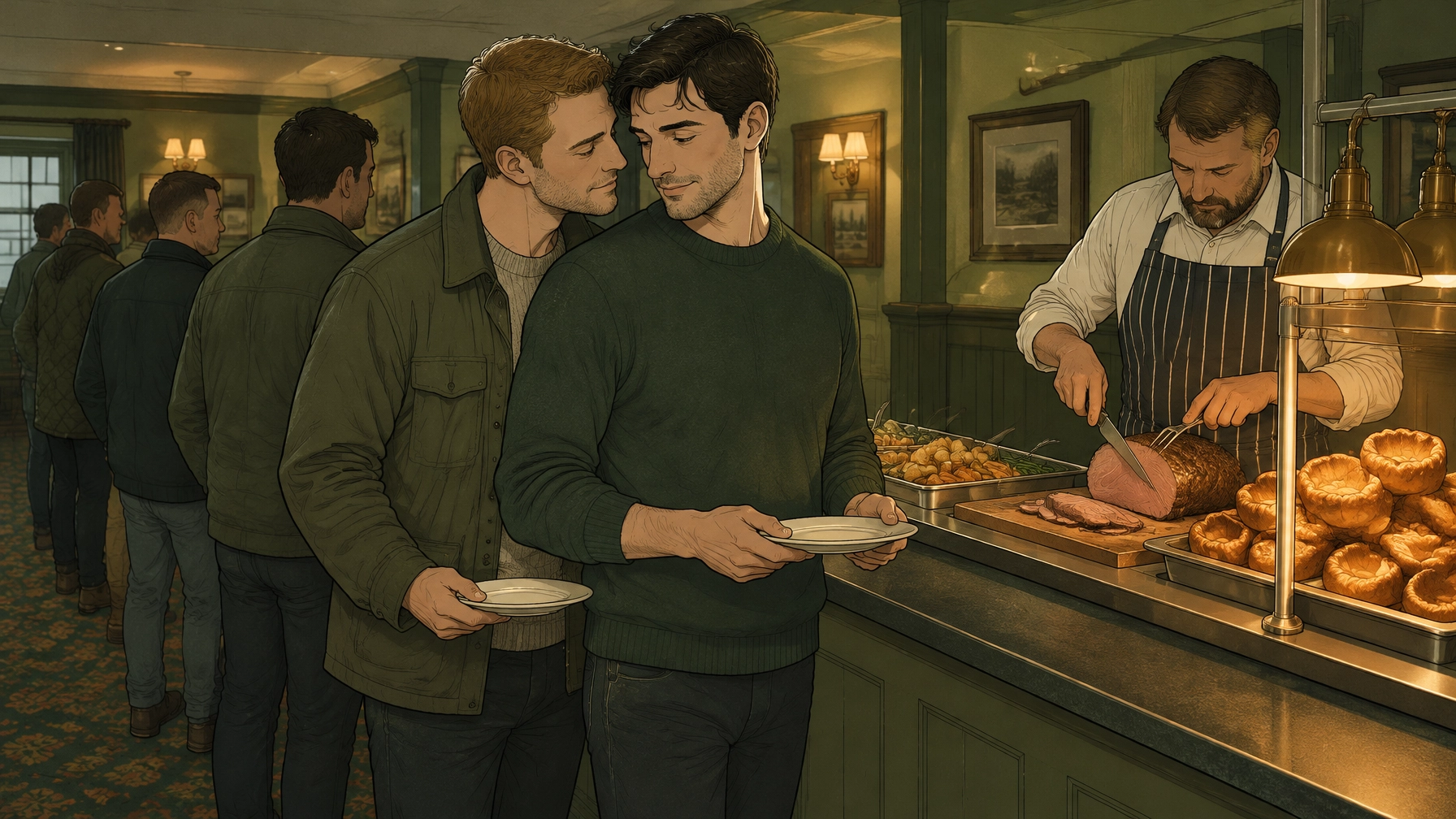
The Roebuck was a plain suburban pub with an ordinary carpet and a carvery counter bright beneath its heat lamps. By the time they joined the queue, the plates were warm in their hands. A man in an apron carved the meat while a stack of Yorkshire puddings waited under a lamp.
Elias took Jonah’s plate from him and carried both.
“Peas? Stuffing?” the carver asked.
“Both, please,” Elias said, before Jonah had looked at the trays.
Jonah glanced at him. Elias kept his attention on the counter, carrying both plates as carefully as if they were more important than they were.
Elias orders before Jonah can read the board
He was good at making small things easier. He knew what Jonah liked, where the awkward pause might land, when a question could be answered in half the time if he answered it first. It was a kindness with good intentions and poor timing.
At the table, a paper menu lay beside a beer mat wedged under one leg. Elias’s father was already there, his coat still hanging on the back of his chair. He stood to greet them. The handshake was formal, his grip brief, his expression carefully open.
“What do you do, Jonah?” he asked.
“He’s…” Elias began.
“I can answer that,” Jonah said, lightly. “I’m in accounts.”
Elias’s father gave a small nod. The joke landed, and they moved on. Jonah had been out for about eight years. His bisexuality was not a secret, but that did not mean he wanted someone else to bring it into the room for him.
Readers searching for MM romance unexpected places often want love to feel at home in an ordinary room, not only in a grand declaration. Here, a carvery queue and a slightly wobbly table give a relationship plenty to work with.
The question about Jonah’s lot
They ate roast potatoes and passed the gravy jug. The room was loud enough that Elias’s father sometimes had to raise his voice, though he kept his questions plain.
“And your lot know about all this, then? Your family?”
He meant Jonah’s family. He asked it clumsily, like someone looking for a simple answer to a question that did not come with one. He was not trying to make trouble. He was trying to understand, and had chosen the wrong shape of words.
Before Jonah could reply, Elias spoke.
“Not every family gets there as fast as ours did, Dad.”
It was protective. It was also a little noble, and entirely Jonah’s to answer.
Elias’s father looked from his son to the man beside him. His face changed, not into anger, but into care. He lowered his voice and began choosing each word before he said it. That made the table feel smaller.
What it feels like to have nothing to say in your own introduction
For half a second, Jonah had nothing to say.
A truthful sentence had been ready. Then Elias filled the space where it needed to go, and the sentence disappeared. Jonah noticed his own mouth was open. He was not angry. He was tired in a precise way, as if he had been holding a door for too long and had only just realised it was not his to hold.
For readers seeking a gay love story emotional journey, this is a familiar kind of tension: not a dramatic breach, but a loving gesture that takes up the room someone else needs. The quietest moments in queer fiction can carry the weight of who gets to speak, and when.
Two plates, a napkin, and a hand that stops halfway
Elias’s father held his napkin in one hand. His other hand rested near his plate. He seemed to want to say something more, then thought better of it. The silence that followed was not hostile. It was merely awkward, the way a silence between two people who have just met properly can be.
Then Elias’s hand came up.
It was a small movement, a half-raise, the palm already turning as though it meant to take the silence and put something into it. It stopped in the air above his fork. Jonah watched him notice it. The hand came down and lay flat on the tablecloth, fingers spread, as if it had been told to stay there.
His father looked at the hand, then at his plate, and said nothing about it.
Elias had arranged this lunch himself. Three weeks earlier, at Jonah’s younger brother’s party, he had watched the brother answer a question plainly, without a preamble and without a rescue, and afterwards he had told Jonah it made him think he could do the same with his father.
That is the kind of detail character-driven queer fiction can hold without turning a person into a lesson. Elias is not a villain for trying to protect Jonah. He is a man noticing, mid-gesture, that good intentions do not always leave room for someone else’s voice.
Saying your own sentence at a table that can take it
Jonah picked up his fork. The Yorkshire pudding beside his potatoes had gone soft at the edge.
“My family know,” he said. “It took a while. My dad needed about a year, but he got there. My brother got there about three weeks ago, at his own party.”
Elias’s father took that in. He did not rush to smooth it over.
“That’s a long time to wait for people to catch up,” he said.
It was not quite an apology. It was not meant to be one. He sounded as if he had understood that a year could feel long from inside it.
The room carried on around them. A plate clinked at the counter. The man carving meat called the next order. No one at the table had to declare the moment fixed.
“Where are you two living now, then?” his father asked. “Still that flat with the stairs?”
Jonah was already opening his mouth when he saw it happen. Elias’s hand came up again, quickly this time, and this time it did not stop in the air. It stopped on the table. He put it down deliberately, beside his fork, where it had been before.
“Still the flat with the stairs,” Jonah said. “The stairs are still the worst part.”
“Stairs usually are,” his father said.
That was all. Nobody congratulated anybody. The gravy was passed, and the carvery queue shuffled forward at the counter, and the afternoon went on being an afternoon.
Emotionally invested MM readers know that a scene can turn on a simple sentence spoken without anyone claiming it as their own. Jonah’s answer does not settle every feeling. It gives him back the chance to make it.
The pavement outside, and the thing Elias admits
When they stepped outside, dusk had settled over the pavement. The pub windows glowed behind them. Elias stood close, hands in his coat pockets, and looked at the ground for a moment.
“I do it because it’s faster,” he said. “I learned it at fourteen. Rooms needed managing. I never stopped.”
He did not say it as an excuse, and he did not ask Jonah to make him feel better about it. He simply put the fact between them, the way he put a plate down: squarely, in reach.
“I know,” Jonah said. “Do it less.”
Elias nodded once.
The phrase emotional MM romance literary points to a kind of story that lets small choices carry the emotional weight. This is one of them: an admission, a direct answer, and no demand that either man make the moment bigger than it is.
Come on a Tuesday, not for the carvery
At the door, Elias’s father had finally put his coat on, and looked faintly sorry to be wearing it. He gave Jonah an awkward half-wave, then seemed to reconsider and offered his hand again. This time the handshake was less formal.
“Come on a Tuesday,” he said. “Not for the carvery. The carvery’s terrible.”
Elias smiled. “You arranged Sunday lunch.”
“I know what I arranged,” his father said. “That’s how I know.”
There was a dry little smile in his voice. It was the first joke he had made that afternoon, and it suited him.
On the drive home, darkness gathered over the road. Rain began to spot the windscreen. Elias kept both hands on the wheel, where Jonah could see them.
“Left at the next lights?” Jonah asked.
“Left,” Elias said.
The wipers swept the glass and the streetlights came and went. At the junction, Elias said, “You could have let me answer for you.”
“I could have.”
“I know you don’t want that.” He indicated left. “I’m practising.”
The rain thickened across the windscreen. Neither of them said anything else about it, and Jonah let the quiet hold.
A note from Read with Pride
Read with Pride brings together LGBTQ+ ebooks, gay fiction, gay romance books, M/M books, MM novels and queer fiction. You can explore the Read with Pride collection.
Follow us on social media
Instagram · X · Facebook · Read with Pride
#QueerLifeAndIdentity #MMRomance #GayRomance #BisexualRepresentation #QueerFiction #GayFiction #MMFiction #LGBTQBooks #EmotionalMMRomance #CharacterDrivenFiction #ReadWithPride #ReadingWithPride
Three stories we could tell next
1) The Chip Shop on a Tuesday — Elias’s Father Asks Them Back, and Nobody Softens Anything
The return visit Elias’s father actually wants takes them somewhere with worse food and fewer people, where Elias has to practise stopping himself.
2) What Marcus Kept in the Flat Before Theo — A Box, a Photograph, and the Years He Does Not Describe
Theo finds something from Marcus’s years of keeping love at a distance, and has to decide whether to ask.
3) The Mate Who Asks Again — A Second Invitation, and What It Costs to Say Yes
The five-a-side mate invites Jonah and Elias to a thing of his own, and Jonah weighs being ordinary in one room against being ordinary in another.


Leave a Reply
You must be logged in to post a comment.