

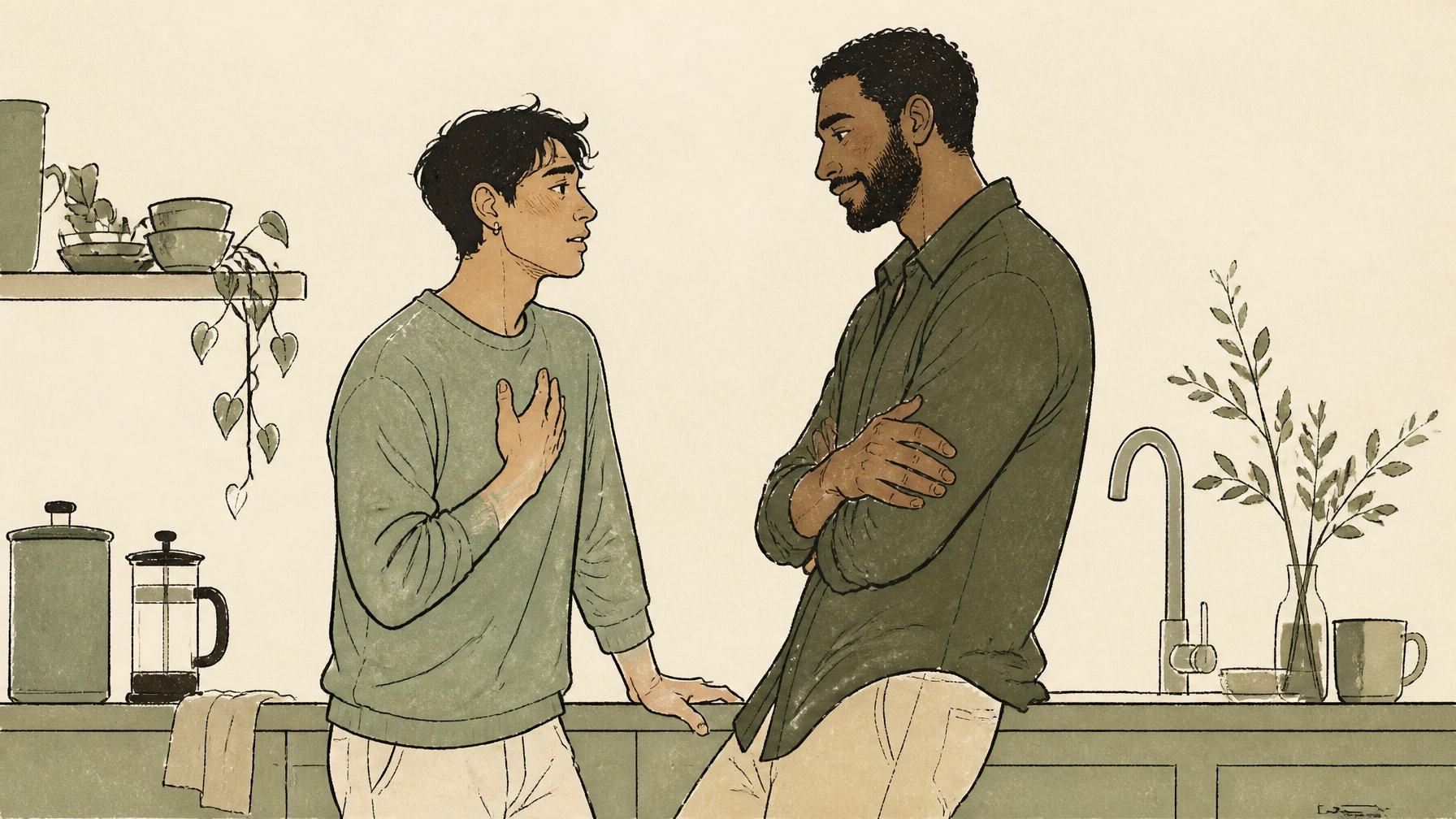
There is a particular kind of silence that comes before the words.
Not always an unhappy silence. Sometimes it is thoughtful. Sometimes it is protective. Sometimes it is the quiet of a man standing in front of the bathroom mirror, trying out a sentence that feels too large for the room.
“I’m gay.”
“I’m bi.”
“I’m queer.”
The words may be simple. The feelings behind them rarely are.
In the previous instalment of the Queer Life and Identity series, we explored the language we choose: names, pronouns, labels, and the deeply personal work of deciding what feels like ours. This time, we are moving from private language to spoken truth : to coming out, coming in, and the question so many queer men carry with them:
When is the right moment to say it aloud?
The first audience is often ourselves
Before we tell another person, many of us tell ourselves.
Sometimes that happens clearly, in a single moment. A man sees another man across a crowded room and understands something he has been trying not to understand. He falls in love with a male friend. He reads a gay love story and recognises an emotional truth he thought belonged only to fictional characters.
Sometimes it happens gradually.
A word feels right for a week, then wrong for a month. “Gay” may offer relief, while “bi” gives a man space to describe the fullness of his experience. “Queer” may feel open, defiant, or more honest than anything narrower. There is no prize for choosing quickly, and no failure in changing the language later.
Coming in : coming home to yourself : is not about producing a perfect definition. It is about allowing your feelings to exist without putting them on trial.
That can take time. It can also take courage.
Coming out is not one grand announcement
Stories often treat coming out as a single dramatic scene: a confession across a dinner table, a slammed door, a tearful embrace. Those moments do happen, but they are only one version of a much larger experience.
Coming out can be a series of small disclosures.
You tell one trusted friend. You let yourself mention that you are attracted to men. You stop correcting people when they assume you are straight. You tell someone about the man you are seeing. You write the words in a message and leave them unsent for three days.
Each moment can carry its own emotional weight.
For some queer men, coming out brings relief. For others, it brings grief for the years spent hiding, or fear about what may change. Sometimes joy and terror arrive together. You can feel proud of who you are and still be unsure whether another person will treat that truth gently.
That uncertainty does not make your identity less real. It makes you human.
Eli practises the sentence
Eli had known for a long time.
He knew in the way he watched certain men without meaning to. He knew in the way his chest tightened when his friend Daniel laughed, head tilted back, entirely unaware of how much space he occupied in Eli’s thoughts.
But knowing privately was different from saying it.
One evening, Eli sat in his parked car outside Daniel’s flat. The engine was off. Rain moved slowly across the windscreen, turning the streetlights into soft green and gold blurs.
He had rehearsed several versions.
“I need to tell you something.”
“I think I’m gay.”
“I like you.”
The first two felt frightening. The third felt impossible.
So Eli started with the smallest true thing. He sent a message to his cousin : the person who had always made room for difficult conversations.
There’s something about me I’ve been trying to say.
His cousin replied almost immediately.
Take your time.
That was all. No demand. No pressure. Just permission to breathe.
Eli did not tell Daniel that night. He did not tell everyone the next morning. But he had crossed an important distance. The truth was no longer locked entirely inside him.
Sometimes the first time we say it aloud is not a declaration to the world. Sometimes it is a quiet sentence spoken to one safe person, in a car, over the phone, or into the darkness of our own bedroom.
It still counts.
Finding the right moment means finding a safe enough moment
There is no universal timetable for coming out. The “right moment” is not necessarily the most dramatic, romantic, or morally satisfying one. It is the moment that takes your circumstances seriously.
Ask yourself:
- Do I feel emotionally ready to share this?
- Is the person I am telling likely to respond with care?
- Could this conversation affect my housing, finances, education, employment, or physical safety?
- Do I have someone supportive to contact afterwards?
- Would writing a message feel safer than speaking face to face?
- Am I telling this person because I want to, or because I feel pushed?
Waiting is not cowardice. Privacy is not dishonesty. You are allowed to protect yourself while you decide what comes next.
For one man, the right moment may be a quiet walk with a trusted friend. For another, it may be a letter because writing allows him to say everything without being interrupted. Someone else may begin by joining an LGBTQ+ community online, reading other men’s stories, or speaking with an affirming counsellor.
There is no single correct doorway into your own life.
The particular pressure placed on queer men
Many men are taught to keep vulnerability hidden.
They may be encouraged to appear certain, sexually confident, emotionally controlled, and unaffected by rejection. Saying “I’m gay,” “I’m bi,” or “I’m queer” can challenge several expectations at once. It may reveal not only who a man desires, but how deeply he feels, how afraid he has been, and how much he wants to be known.
This is one reason character-driven queer fiction matters.
In the best MM romance, identity is not treated as a label placed neatly on a character’s file. It lives in gestures, evasions, arguments, silences, and moments of tenderness. A man may understand his feelings long before he has the language to explain them. He may want another man desperately and still fear what wanting means. He may confuse jealousy with anger, or emotional distance with strength.
A gay love story emotional journey becomes powerful when it honours those contradictions.
The most compelling emotional MM romance literary readers often seek is not built around a flawless declaration. It is built around the slow, difficult movement towards honesty : and the question of whether love can make room for a person who is still learning how to make room for himself.
Coming in to community
Coming out is often described as becoming visible. Coming in can be understood as becoming connected.
That connection may begin with another man who understands the fear behind your jokes. It may be found in a book, a film, a conversation, or a community where you do not have to explain every part of yourself. It may arrive when you realise that queer men have been living, loving, arguing, creating, and building meaningful lives for generations.
Community does not require you to perform certainty.
You can be questioning. You can be private. You can be newly out, out in some places but not others, or still deciding which words belong to you. You can be a gay man, a bi man, or a queer man without having a complete speech prepared.
Belonging is not something you earn by knowing everything. It is something you practise by allowing yourself to be present.
What happens after the words?
Sometimes the listener responds beautifully.
Sometimes they need time. Sometimes they surprise you. Sometimes they reveal that they are not safe enough to hold this part of your life, and you have to step back.
Their reaction may affect you, but it does not define the truth you shared.
After coming out, give yourself space to feel more than one thing. Relief can sit beside sadness. Pride can exist alongside exhaustion. Happiness can be interrupted by the realisation that you have been carrying fear for years.
Try not to demand instant transformation from yourself. You do not have to become fearless simply because you have spoken. You do not have to tell everyone immediately. You do not have to turn your identity into a public performance.
The first words are important. So are all the quieter choices that follow: accepting affection, setting boundaries, allowing yourself to imagine a future with another man, and believing that your life can contain tenderness without apology.
For emotionally invested MM readers, these are the stories that stay with us. Not because every character finds the perfect moment, but because they keep moving towards a life that feels more honest.
A truth does not need to be loud to be real
There is no correct volume for coming out.
Your truth may arrive as a whisper. It may be typed into a text message. It may be spoken while walking beside someone you trust. It may take years before you can say it without your voice shaking.
All of those moments are real.
If you are still waiting, let the waiting be thoughtful rather than shameful. If you have already said the words, let yourself recognise what that took. And if you are supporting a queer man through his own process, remember that your role is not to force the door open. It is to stand nearby, make space, and listen when he is ready to enter.
For readers drawn to emotionally rich MM romance, heartfelt gay fiction, and character-driven queer fiction, this is where the deepest stories often begin: not with certainty, but with one honest sentence.
You can explore more LGBTQ+ ebooks, gay books, queer fiction, and emotional MM novels through Read with Pride, including Dick Ferguson’s MM romance collection.
Next topics in the Queer Life and Identity series
- The Fear After the Truth: When Coming Out Changes the Way We See Every Relationship
- Learning to Be Desired: Queer Men, Self-Worth, and the Right to Receive Love
- The Men We Become Together: Masculinity, Tenderness, and Building an MM Future
Follow us on social media
Follow Dick Ferguson for more reflections on queer identity, gay love stories, emotional MM romance, and literary LGBTQ+ fiction:
#QueerLifeAndIdentity #ComingOut #ComingIn #GayMen #BisexualMen #QueerMen #MMRomance #GayRomance #MMBooks #QueerFiction #GayFiction #GayNovels #GayLoveStories #MMNovels #LGBTQFiction #GayLiterature #MMFiction #GayRomanceBooks #MMRomanceBooks #LGBTQRomance #EmotionalMMRomance #CharacterDrivenFiction #EmotionallyInvestedReaders #ReadWithPride #ReadingWithPride #LGBTQEbooks #GayBookRecommendations #QueerAuthors #MMAuthors #HeartfeltGayFiction


Leave a Reply
You must be logged in to post a comment.