

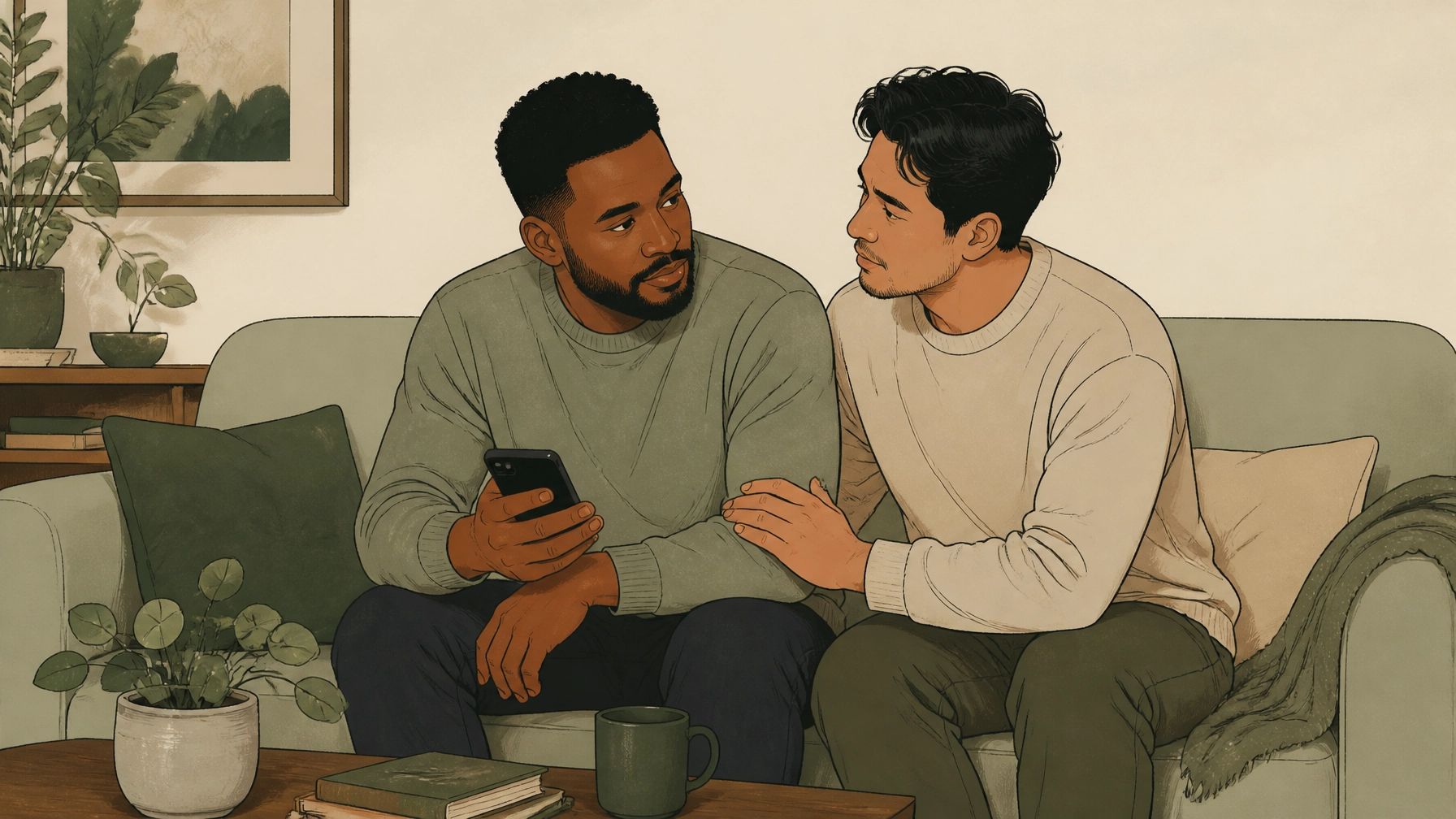
There are questions that sound simple until they land in the middle of your chest.
“Is it serious?”
When the question comes from a brother, it may be asked casually, perhaps while clearing plates after dinner or scrolling through a phone. It may even be meant kindly. But for a gay or bisexual man, hearing it about his male partner can open a much larger conversation.
Serious according to whom?
Does seriousness mean marriage? Living together? A shared mortgage? Children? A photograph on the mantelpiece? Or can it mean something quieter and more intimate: the person who knows how you take your coffee, sits beside you in a hospital waiting room, and stays when life becomes difficult?
In a gay love story, commitment does not need to imitate a traditional script to be real. It only needs to be lived, chosen, and felt.
When “Is It Serious?” Carries More Than One Meaning
A brother asking about a relationship may be trying to understand where things stand. He may be wondering whether to invite the partner to family events, whether this is someone he should get to know, or whether his sibling is emotionally invested.
That curiosity can be genuine. Family members often need time to adjust to a new understanding of someone they love. Coming out is not always one dramatic announcement followed by instant clarity. Sometimes it is a series of conversations, introductions, corrections, and small moments of recognition.
But the same question can also carry an uncomfortable implication: that the relationship has not yet earned the same status as other relationships.
Straight siblings are not always asked to prove that their love is permanent before their partners are welcomed into the family. Their early relationships may be treated as meaningful even when nobody knows how long they will last. A gay or bisexual man, however, may feel that his relationship is being examined under a brighter light.
Is this a phase?
Is this really love?
Will he eventually choose a more acceptable life?
The question about seriousness can become a test, even when nobody admits that a test is taking place.
Commitment Does Not Belong to One Kind of Couple
Families sometimes use familiar milestones as shorthand for commitment. Engagement, marriage, children, and home ownership are visible signs. They make a relationship easy to explain.
But love is not made serious by paperwork alone.
Commitment may look like building a home together. It may look like making space for one another’s fears, supporting a partner through a difficult coming-out journey, or learning how to disagree without turning every conflict into a threat.
For some couples, commitment means marriage. For others, it means a long-term partnership without a wedding. Some men may want children; others may not. Some couples may create a close network of friends and chosen family that is just as important as their family of origin.
There is no single correct shape for an MM relationship.
This is especially important for bisexual men, who may face a different kind of misunderstanding. A bisexual man in a relationship with another man does not become less bisexual because of his partner. His relationship is still a male/male relationship, and it deserves to be understood without suspicion or comparison.
A partner’s gender does not determine how deeply someone can love. Nor does it decide whether a relationship is worthy of respect.
The Emotional Journey Behind a Simple Family Conversation
Imagine the scene.
A man has just ended a phone call with his brother. His partner is sitting across the room, pretending not to listen. The conversation was not hostile. That almost makes it harder to understand.
“Is it serious?” the brother asked.
Now the question hangs between them.
The man may feel defensive first. Then embarrassed for feeling defensive. Then frightened that his partner heard something he was not ready to say aloud.
Perhaps he has wanted his family to accept this relationship from the beginning. Perhaps he has insisted that he does not need their approval. Both things can be true. Independence and longing are not opposites. A person can know that his love is valid and still ache when the people who raised him hesitate to treat it as important.
His partner may have a different fear. He may wonder whether he will always be introduced with a quiet qualification, as if he is waiting for approval. He may worry that the family sees him as temporary because the relationship is between two men.
That is where the gay love story emotional journey becomes so powerful. The tension is not only between the couple and the family. It can move through the couple, too.
One man wants recognition.
The other wants reassurance.
Both may need to ask what they are building together, separate from the expectations surrounding them.
Character-Driven Queer Fiction Lives in These Moments
The most affecting relationship stories are often built around ordinary conversations.
A brother asking whether the relationship is serious is not an action-movie crisis. Nobody has necessarily slammed a door. There may be no dramatic speech. Yet the question can reveal years of family expectations, old insecurities, and the quiet pressure to make queer love legible to other people.
This is where character-driven queer fiction finds its emotional force.
One character may have spent his entire life trying to be easy for his family to understand. He answers questions carefully, softens his opinions, and avoids asking for too much. His partner may be the first person who sees how exhausting that has become.
Another character may be openly certain about his relationship but deeply afraid of being rejected. He jokes when he feels threatened. He says, “It doesn’t matter what they think,” while watching the phone for a reply.
The brother, too, can be written with complexity. He may not be a villain. He may be awkward, uninformed, or genuinely trying to learn. He may believe he is being supportive without recognizing that his language places the relationship under examination.
Good queer fiction allows everyone in the room to be human without pretending that harm disappears simply because it was unintended.
What Can You Say When Someone Asks?
There is no single right response. The best answer depends on the relationship, the setting, and whether the conversation feels safe.
A man might say:
“It’s serious because we’re committed to each other. It may not look exactly like the relationships you grew up expecting, but it matters deeply to both of us.”
Or:
“When you ask if it’s serious, what are you really trying to understand?”
That second question can open the door to a more honest conversation. Perhaps the brother is asking how long they have been together. Perhaps he wants to know whether his sibling is happy. Perhaps he is struggling with the idea that this partner is becoming part of the family.
It is also acceptable to set a boundary.
“I’m happy to talk about my relationship, but I don’t want to feel as though I have to prove that it counts.”
A relationship does not become valid because relatives approve of it. Family recognition can be healing, but it is not the source of the couple’s worth.
The couple may also decide together what they want from the family. Do they want an apology? An invitation? A simple change in language? Do they want the brother to make an effort with the partner rather than asking private questions about the relationship?
Clarity can turn a painful moment into a useful one.
Why Gay Love Deserves the Same Emotional Weight
A gay love story is not a lesser version of a straight one. It does not need to be tidied into a lesson or defended through tragedy. It can be tender, awkward, funny, sensual, complicated, domestic, furious, hopeful, and deeply ordinary.
Two men can fall in love in a crowded city, at work, through friendship, during a difficult year, or in the middle of a life they thought they already understood. That is part of the appeal of MM romance unexpected places: love can arrive where a character has stopped looking for it.
The relationship may begin with uncertainty. It may carry the weight of coming out, bisexuality, family history, jealousy, or old shame. But those challenges do not make the love less romantic. They often make the emotional stakes clearer.
For emotionally invested MM readers, the question is rarely only whether the couple will end up together. The deeper question is whether they will allow themselves to be fully known. Will they accept tenderness without suspicion? Will they stop treating happiness as something that must be defended? Will they choose each other even when the world asks them to explain?
That is the heart of emotional MM romance literary storytelling: not simply the promise of a relationship, but the transformation that makes lasting love possible.
Let the Relationship Define Its Own Future
The brother’s question may be uncomfortable, but it can also become a turning point.
The couple might talk about the future for the first time. Not because the family demanded proof, but because they want to understand one another better.
What does home mean to them?
How do they want to handle family gatherings?
Which traditions do they want to keep, and which ones do they want to reshape?
What would it mean to be committed without performing commitment for an audience?
There is freedom in asking those questions on their own terms.
A serious relationship is not one that looks impressive from the outside. It is one in which both people can speak honestly, make room for change, and remain present through the difficult parts. It is a relationship where love is not treated as a temporary exception to the family story.
It is part of the family story.
And whether it leads to a wedding, a shared flat, a chosen-family gathering, or simply years of mutual care, it deserves the same emotional weight as any other love story.
For readers drawn to heartfelt gay fiction, emotionally rich gay novels, and character-driven queer fiction, these are the moments that stay with us. The question may begin with “Is it serious?” But the answer is found in everything that follows.
Continue Reading with Pride
Discover more LGBTQ+ ebooks, gay books, MM romance books, queer fiction, and emotional gay love stories through Read with Pride. You can also explore Dick Ferguson’s available MM novels and gay romantic fiction for stories shaped by vulnerability, desire, identity, and the complicated work of loving another man honestly.
Follow us on social media
Follow Dick Ferguson for new releases, literary reflections, character-driven MM romance, and reading recommendations:
Three ideas for the next Queer Life and Identity instalment
- When His Family Uses the Wrong Pronouns for His Partner: The Emotional Work of Correcting People You Love
- The First Holiday After Coming Out: Creating New Traditions When Old Family Rituals Feel Different
- When His Partner Meets His Closest Friends: Chosen Family, Belonging, and the Fear of Being Seen
#MMRomance #GayRomance #QueerFiction #GayFiction #LGBTQFiction #MMNovels #GayLoveStory #EmotionalMMRomance #CharacterDrivenFiction #QueerLifeAndIdentity #LGBTQReading #GayBookRecommendations #ReadWithPride #ReadingWithPride #GayAuthors #QueerAuthors


Leave a Reply
You must be logged in to post a comment.