

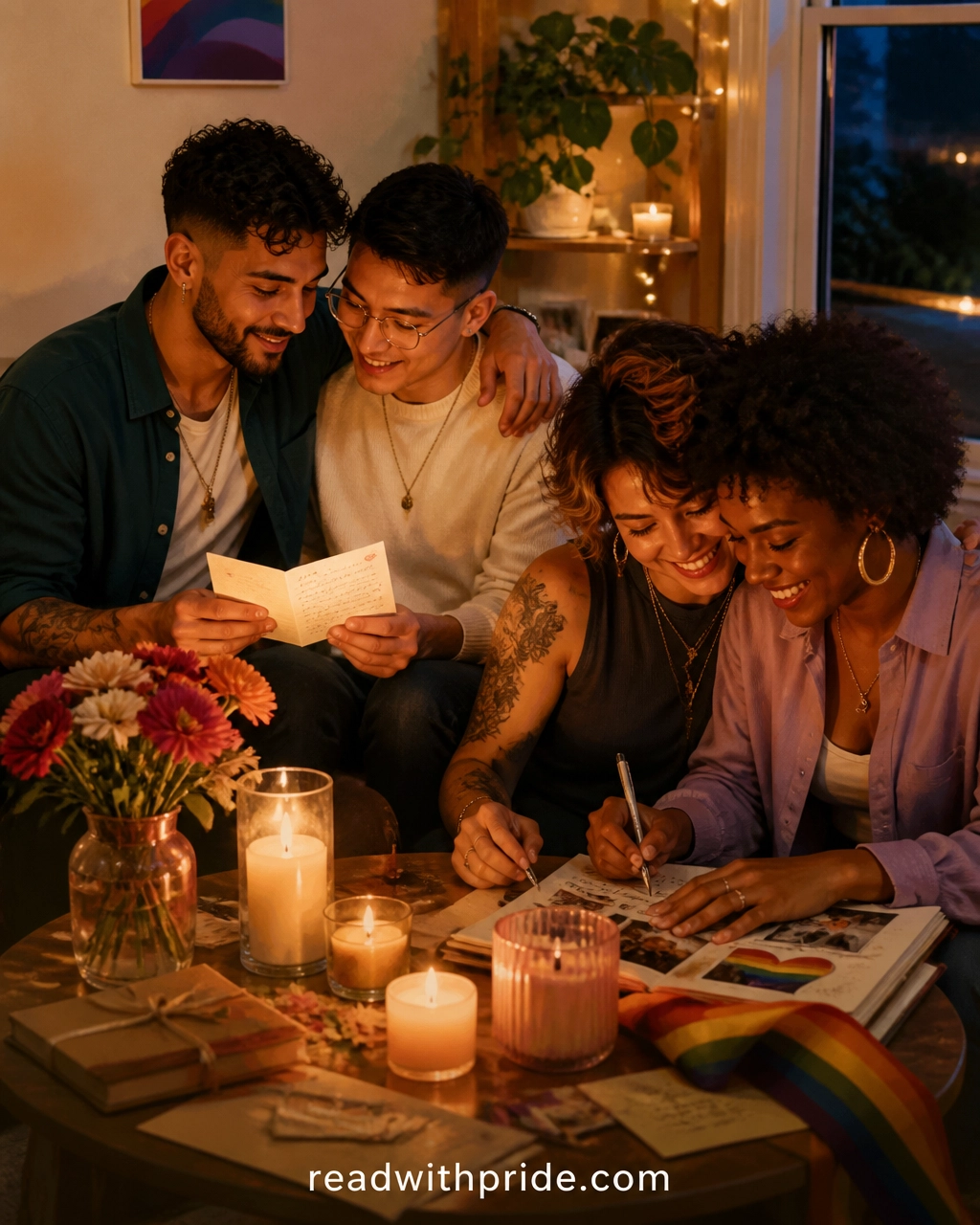
There is a familiar relationship script many of us absorb without ever agreeing to it.
Meet someone. Date. Become official. Move in. Get engaged. Get married. Buy a home. Celebrate anniversaries in a way that looks reassuringly recognisable from the outside.
But queer relationships have never needed to follow one approved route to be real.
For many LGBTQ+ couples, the most meaningful life milestones are the ones they create themselves: a commitment ceremony without legal paperwork, an anniversary that celebrates the day they chose each other, a first shared holiday with chosen family, or the moment a new home begins to feel like theirs.
There is no single straight script for marking love. That is not a problem to solve. It is an invitation to make something more personal.
At Read with Pride, we are continuing our series on queer relationships and the moments that give them shape. This time, we are exploring commitment, ritual, found family, healing, and the rich MM romance themes that remind us love can be built on our own terms.
Commitment Does Not Need One Official Shape
Marriage can be meaningful. So can a long-term partnership without marriage. So can a commitment ceremony, a shared home, a co-parenting arrangement, a queerplatonic partnership, or a relationship structure that does not fit neatly into a familiar category.
Commitment is not defined by one word. It is defined by the promises people make and keep.
For one couple, commitment might mean exchanging rings at a small ceremony surrounded by friends. For another, it might mean becoming each other’s emergency contact, making a care plan for the future, or agreeing that the cat belongs equally to both of them despite having clearly chosen one favourite.
Some couples choose monogamy. Others build open relationships or polyamorous partnerships. Some people share a home, while others remain deeply committed across separate households. The important thing is not whether a relationship resembles a traditional model. It is whether everyone involved has the space to consent, communicate, and feel respected.
That intentionality is central to many MM romance books. The characters are not simply handed a ready-made future. They have to ask what love means to them, what safety looks like, and which expectations they want to keep or leave behind.
Inventing a Commitment Ceremony
A commitment ceremony can be as elaborate or as simple as the people involved want it to be.
It might take place in a registry office, a garden, a community hall, a favourite restaurant, or a living room with mismatched chairs. It might include vows, rings, readings, music, food, and a guest list that includes friends who have been family for years.
The point is not to reproduce a traditional wedding perfectly. The point is to create a ritual that reflects the relationship.
Some couples adapt familiar symbols:
- Lighting a unity candle to represent two lives joining.
- Planting a tree or herbs that will grow alongside the relationship.
- Exchanging handwritten promises instead of formal vows.
- Creating a time capsule to open on a future anniversary.
- Asking chosen family to offer readings, blessings, or personal memories.
- Walking into the ceremony together rather than being “given away.”
- Using language such as partners, beloveds, spouses, or simply the names that feel right.
These details matter because rituals help us say, “This is important. This deserves to be witnessed.”
For LGBTQ+ couples, that witnessing can carry particular emotional weight. Many relationships have existed in environments where they were ignored, questioned, hidden, or treated as less legitimate. A ceremony does not need external approval to be meaningful, but gathering the people who understand your journey can make commitment feel visible and held.
Anniversaries Can Celebrate More Than a First Date
A queer anniversary does not have to mark the first time two people went on a date.
It might celebrate the day they met, the day they became official, the day they moved in, the day one partner came out to the other, or the day they decided to try again after a difficult separation.
Second-chance romance makes space for this kind of layered history. In many gay romance novels, the most important anniversary is not the beginning of the relationship but the moment two characters choose honesty after years of fear, distance, or misunderstanding.
An anniversary might mark:
- The first “I love you.”
- The first time a partner met chosen family.
- The day trust was rebuilt.
- The first shared home.
- A commitment ceremony.
- The decision to begin again.
- The first holiday spent openly together.
- The day both partners realised they were no longer imagining a future separately.
Some couples write letters to one another every year and seal them away to read later. Others revisit the place where they first met. Some cook the same meal, buy a new plant, recreate an old photograph, or spend the day doing absolutely nothing except being together.
A ritual does not have to look impressive on social media. It only has to mean something to the people inside it.
The First Shared Holiday
The first holiday together can be joyful, complicated, or both.
There may be questions about whose family to visit, whether it is safe to be openly affectionate, how chosen family fits into the day, and which traditions are worth carrying forward. For some couples, the holiday is their first time being introduced as partners. For others, it is the first celebration they design from scratch.
Queer couples often create new traditions because old ones may carry painful memories or assumptions that no longer fit.
A first shared holiday might involve:
- Hosting friends who would otherwise spend the day alone.
- Combining two cultural or religious traditions.
- Creating a low-pressure celebration without compulsory family roles.
- Inviting ex-partners, friends, or community elders who remain important.
- Making a new meal together every year.
- Exchanging meaningful objects instead of expensive gifts.
- Spending part of the day together and part of it separately, with no guilt attached.
This is where found family becomes more than a phrase. It becomes an active practice of making room.
In lesbian romance as well as MM fiction, holiday scenes often reveal the emotional architecture of a relationship. Who gets invited? Who feels safe? Who knows how to help when the room becomes overwhelming? Who saves the last piece of dessert?
Sometimes romance is the grand declaration. Sometimes it is quietly making sure someone has a plate.

Meeting the Chosen Family
Introducing a partner to biological relatives can be a major step, but meeting chosen family may carry an even deeper meaning.
Chosen family includes the people who have shown up consistently: friends, former partners, neighbours, mentors, colleagues, queer elders, community members, and the person in the group chat who always knows when to send soup instead of advice.
When a new partner meets these people, they are being welcomed into the real structure of someone’s life.
The occasion does not need to be formal. It could be a Sunday dinner, a birthday, a Pride gathering, a book club, or a chaotic picnic where three people bring crisps and nobody brings plates. The milestone may arrive in a tiny moment: someone offers your partner the usual mug, adds them to the group chat, or asks what they would like for the next holiday.
That is belonging in action.
Our earlier post, Queer Relationships and Life Milestones: Coming Out, Chosen Family, and Every Love Story in Between, explores how chosen family shapes queer lives. You can also revisit The Quiet Milestones That Shape Queer Love and Queer Love at Every Age for more reflections on intimacy, identity, and relationships that refuse to follow a timetable.
A First Home Is a Ritual Too
Moving in together is often treated as a practical milestone involving boxes, broadband installation, and discovering that one person owns seventeen mugs but only uses two.
For queer couples, a first home can represent something much bigger.
It may be the first place where the relationship is fully visible. It may be the first address where both partners feel safe. It may be a space where they can decide what family life looks like without asking permission from anyone else.
A shared home can include a weekly queer book club, Sunday dinner with friends, an open-door policy for chosen family, or a quiet corner where one partner reads gay fiction while the other watches television. It can be colourful, minimalist, chaotic, peaceful, temporary, permanent, or still surrounded by unpacked boxes six months later.
The home becomes a living ritual: the same morning coffee, the shared grocery list, the spare key, the familiar side of the bed.

Slow Burn, Healing, and the Courage to Stay
Some of the most powerful MM romance themes are found family, slow burn, second chance, and healing.
These themes work because they understand that commitment is rarely created in one dramatic scene. It grows through repeated choices.
You listen. You apologise. You return to a difficult conversation. You learn someone’s boundaries. You ask what they need instead of assuming. You stay present when the relationship is joyful, awkward, frightened, or imperfect.
In a slow-burn romance, the emotional milestone may be a hand held without hesitation. In a second-chance story, it may be the first honest conversation after years apart. In a healing romance, it may be the moment a character realises love does not need to feel like danger in order to be powerful.
Lesbian romance offers these emotional journeys too: women building a shared life after loss, finding love later in life, balancing independence with intimacy, or creating a home that includes friends and community as much as romance.
The most satisfying queer love stories do not suggest that a relationship magically fixes everything. They show people becoming more honest, more supported, and more able to imagine a future.

Your Milestones Do Not Need Permission
There is no required order for queer life milestones.
You can celebrate an anniversary without a wedding. You can have a commitment ceremony without legal paperwork. You can create a family without following a traditional structure. You can share a home, keep separate homes, love one person, love several people, or build a life centred on friendship and community.
You can mark the first holiday, the first key, the first family photograph, the first repaired disagreement, or the first time someone says, “We,” and means it.
Your rituals belong to you.
That is the heart of queer relationships: not rejecting every tradition, but choosing which ones nourish you and inventing new ones when the old script does not fit.
Explore Read with Pride for MM romance books, gay romance novels, lesbian romance, LGBTQ+ novels, queer fiction, and heartfelt stories about people building lives with courage and care. Visit our LGBTQ+ blogs and articles for more from this series, follow Readwithpride on Instagram, and connect with Read with Pride on Facebook.
Whether you are searching for coming out stories, a queer book club read, LGBTQ+ fiction 2026, gay fiction, queer love stories, or the mysteriously specific phrase C Section 2026, there is room for your curiosity here.
Love does not need a universal script.
It needs room to become itself.
#ReadWithPride #Readwithpride #QueerRelationships #LifeMilestones #MMRomanceThemes #MMRomanceBooks #GayRomanceNovels #ComingOutStories #QueerBookClub #LGBTQFiction2026 #GayFiction #LGBTQNovels #QueerLoveStories #LesbianRomance #ChosenFamily #FoundFamily #SlowBurnRomance #SecondChanceRomance #QueerFiction
{“@type”:”BlogPosting”,”image”:[“https://cdn.marblism.com/kzT3nHvKrSo.webp”,”https://cdn.marblism.com/CQjUzjlTxJZ.webp”,”https://cdn.marblism.com/9-T9ZzXsQbv.webp”,”https://cdn.marblism.com/-mWlQyIY4Tg.webp”],”author”:{“url”:”https://readwithpride.com”,”name”:”Read with Pride”,”@type”:”Organization”},”@context”:”https://schema.org”,”headline”:”LGBTQ+ Relationships and Life Milestones: The Milestones We Invent — Commitment, Ritual, and Queer Love on Our Own Terms”,”keywords”:[“queer relationships”,”life milestones”,”MM romance themes”,”Read with Pride”,”MM romance books”,”gay romance novels”,”coming out stories”,”queer book club”,”LGBTQ+ fiction 2026″,”C Section 2026″,”gay fiction”,”LGBTQ+ novels”,”queer love stories”,”lesbian romance”,”chosen family”,”found family”,”slow burn romance”,”second chance romance”],”publisher”:{“url”:”https://readwithpride.com”,”logo”:{“url”:”https://cdn.marblism.com/3frC7pIx901.jpg”,”@type”:”ImageObject”},”name”:”Read with Pride”,”@type”:”Organization”},”inLanguage”:”en”,”description”:”Explore how queer couples create their own commitment milestones and rituals, from anniversaries and commitment ceremonies to shared holidays, first homes, chosen family, healing, and queer love on their own terms.”,”dateModified”:”2026-08-28″,”datePublished”:”2026-08-28″,”articleSection”:”LGBTQ+ Relationships and Life Milestones”}

Leave a Reply
You must be logged in to post a comment.